



Everyday inquiry is considerably older than universities and their formalised sciences. We have probably engaged in testing, reflection and sharing of experience for as long as we have been able to speak. During the scientific revolution of the seventeenth century, however, we took an important step forward when systematic observations, experiments and explicit methods began to be used more widely. This happened mostly in practical settings outside university walls. It was not until the nineteenth century that research became an institutionalised mission within academia, with established organisations, professional roles and career structures. Before that, medieval universities had primarily been tasked with preserving and transmitting established doctrine – not with generating new knowledge.
Everyday inquiry as a concept, as used in this handbook, therefore connects to an ancient, practice-rooted tradition of working in quite scientific ways. I use the term “everyday inquiry” to describe a non-academic form of systematically documented – and thereby shared – practice, which takes place primarily through iterative, exploratory attempts to develop our own and others’ everyday lives. If by “systematically documented” we mean practice recorded in writing, we can place the starting point of humanity’s everyday inquiry at around 5,000 years ago (around 3000 BCE). Curious and exploratory people certainly existed long before that, but the earliest traces of collective, documented inquiry are found in the early civilisations of Egypt and Mesopotamia.
For most of world history, everyday inquiry has been small-scale, context-bound, and largely controlled by those directly involved. It is only in modern times that this has changed fundamentally. Digitalisation has created entirely new conditions for collecting, analysing and using data about people’s everyday lives. With that, the character of everyday inquiry has also changed – in scale, pace and above all in its balance of power.
In the rest of the chapter, I explore this development and its consequences in more depth, and set it in relation to DAS. I discuss different ways for individuals and collectives to study everyday life, what these mean for professions and organisations, and why everyday inquiry today is a question of ethics, democracy and responsibility.
10.1 The Professional Development Crisis – Prisoners in a Digital Panopticon
For thousands of years, everyday inquiry was controlled by those who actually lived the everyday life being studied. People studied their immediate environments and shared problems, often with limited resources but with deep contextual understanding. Over recent decades, however, this has changed fundamentally. The development of IT, global connectivity and near-infinite computing power have made possible a new form of inquiry: large-scale, continuous and often invisible data collection about people’s learning, work, relationships and behaviour – see Figure 10.1. Everyday inquiry has thereby shifted from being something people do, to something that is increasingly done to people, by actors far beyond their control. Mass inquiry – or, as it is more commonly called, mass surveillance.
Today, working life, welfare services, schools and other sectors of society are studied on an enormous scale. Digital platforms collect data about employees’ efficiency, pupils’ performance, service users’ behaviour and citizens’ movements. Technology companies, consultancies and public authorities analyse these data to predict risks, optimise processes and steer decisions. This typically happens without the professions themselves having any insight into which questions are being asked, which assumptions are built into the systems, or what consequences the analyses have in practice. When professions lack their own inquiry practices, they are reduced to raw material in others’ knowledge production – they become data sources rather than knowledge creators.
It is against this backdrop that the ethical awakening of recent years around data collection and algorithmic governance should be understood. Revelations and analyses from figures such as Edward Snowden, Max Schrems, and Frances Haugen have shown how large-scale algorithmic inquiry, when combined with concentration of power and lack of transparency, risks undermining both professional judgement and democratic values. The crisis of the professions is therefore not about unwillingness or lack of competence – it is about lost control over how professional everyday life is studied and interpreted.
In our time, the question is not whether everyday life is being studied, but by whom – and in whose interest. Professions that do not study their own everyday practice will sooner or later be studied by someone else. Either you are an inquiring practitioner, or you are raw data.

Figure 10.1. The professional development crisis can be understood as a digital panopticon – a prison-like structure of asymmetric visibility in which those being watched never know when they are being observed. Professional everyday life is studied from a distance; analytical power is concentrated away from those it concerns.
10.2 A Four-Quadrant Model of Everyday Inquiry Through the Ages
We will now use a four-quadrant model to show how the study of everyday life has changed over time – see Figure 10.2. Not only in form, but also in scale, pace and balance of power. The model is an analytical tool for understanding everyday inquiry as practice rather than as method, and for showing how different ways of studying everyday life have far-reaching consequences for learning, ethics and professional agency.
The model in Figure 10.2 is built on two fundamental dimensions. First, who studies everyday life – whether this is done by individuals or by collective, even industrial, actors. Second, what tools are used – from simple analogue instruments to increasingly sophisticated digital systems. This gives us four ideal-typical forms of everyday inquiry.
The arrows in Figure 10.2 mark a historical movement that has shaped the development of everyday inquiry over several thousand years. Inquiry has moved largely from individual, small-scale and context-close practice towards increasingly collective, technologically amplified and large-scale data collection. At the same time, the centre of gravity has shifted from everyday reflection and local interpretation to centralised analysis and industrial knowledge production. What began as deep, slow and personal inquiry has gradually become more efficient and generalisable – but also more distant from those whose everyday life it actually concerns.
The purpose of the model is not to romanticise the earlier forms of inquiry or demonise the later ones. Each step in this movement has enabled new insights and new forms of development. At the same time, the model reveals a recurring pattern: the larger the scale and the more sophisticated the tools, the greater the risk that inquiry slides from shared learning towards power, and from participation towards surveillance.
DAS should not be understood in this context as a quadrant of its own, but as a deliberate attempt to combine the possibilities of digital technology with everyday participation, individual responsibility, collective analysis and professional interpretive authority. In doing so, DAS points towards a different way of using the power of inquiry – not by accelerating the shift towards industrialised mass inquiry, but by reclaiming technology, data and analytical power, placing them back in the hands of those it concerns.
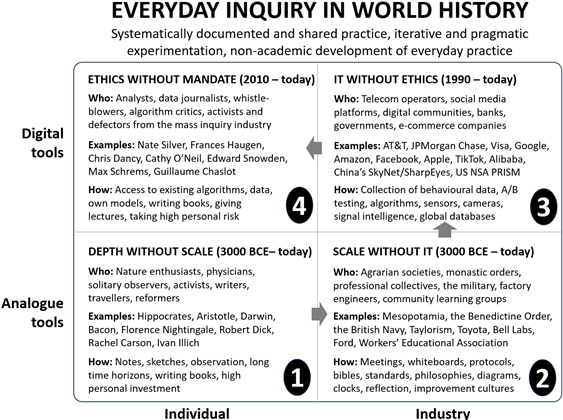
Figure 10.2. The four-quadrant model reveals a historical movement from everyday-close inquiry to large-scale, technologically amplified mass inquiry.
10.3 Quadrant 1: Individual + Simple Tools – The Classic Hero Inquirer
In this quadrant, everyday life is studied by individual people using relatively simple, analogue tools. The inquiry is slow, persistent and deeply rooted in personal experience. It takes place close to what is being studied and is built on repeated observations, reflection and exploratory action over a long period of time. Formal mandates, resources and institutional support are often absent, which makes the work vulnerable – but also highly sensitive to context. The individual inquirer takes their own everyday life seriously as a source of knowledge, and gradually develops a personal system for seeing, understanding and documenting what would otherwise risk remaining invisible.
History is full of examples of this kind of inquirer. Hippocrates laid the foundation for the medical profession through systematic observation of patients. Aristotle combined empirical observation and classification in studies of nature and society. Charles Darwin developed his theory of evolution through decades of careful notes, comparisons and reflections. Florence Nightingale used observation and statistics to fundamentally transform nursing practice during the Crimean War. The geologist and baker Robert Dick devoted his life to everyday observations in his north Scottish surroundings, showing how valuable geological inquiry can grow entirely outside academic settings. Ivan Illich analysed education, medicine and social institutions through sustained reflection on everyday practices, developing his critique as an independent inquirer rather than as part of an established academic research programme. Rachel Carson built her environmental critique on persistent documentation of ecological changes that would otherwise have remained invisible. What these inquirers share is their ability to hold together observation, reflection and action in a coherent, practice-close way over a long period of time – often at the margins of dominant institutions.
Viewed through DAS’s three phases, the pattern becomes clear. Design happens implicitly: the inquirer formulates their own questions based on what sparks wonder in everyday life. Action takes shape in repeated attempts, experiments and changed ways of acting or observing. Sampling happens through careful, often manual documentation in notebooks, sketches, tables and texts, which enables reflection over time. The strength of this quadrant lies in its depth and contextual sensitivity. Its limitation is low scale, high personal burden, and difficulty reproducing the work in larger settings.
Read more:
Svensson, P. (2022). Den lodande människan: Havet, djupet och nyfikenheten [The Sounding Human: The Sea, the Deep, and Curiosity]. Albert Bonniers Förlag.
10.4 Quadrant 2: Collective + Simple Tools – The Learning Organisation
In this quadrant, everyday life is studied collectively by many people, often within organisations or professional collectives, but still using relatively simple tools. The inquiry is less dependent on individual people and more embedded in shared routines, meetings and conversations. Observation, reflection and learning happen collectively and often close to daily practice. The tools can be as simple as whiteboards, stopwatches, minutes, checklists, meeting notes and conversation. Compared to Quadrant 1, robustness and continuity increase, but the inquiry is still strongly dependent on culture, leadership and sustained discipline rather than on technology.
There are many historical and contemporary examples of this kind of inquiry. The Benedictine Order developed early collective forms of systematic everyday reflection through regular observations, shared conversations and carefully preserved documentation of work, learning and ways of living across generations. The British Navy used reporting, logbooks and collective analysis of naval battles, navigation and accidents to gradually improve safety, efficiency and tactical decision-making in complex environments. Frederick Taylor’s time-and-motion studies in the early twentieth century can be seen as an early attempt to systematise collective observation of work, even if the interpretation was strongly centralised. Toyota developed forms of continuous improvement work after the Second World War in which employees’ everyday observations and reflections played a central role. Bell Labs combined everyday experimentation with collective analysis in cross-disciplinary environments. In the public sector, community learning groups, quality improvement circles and local improvement work have functioned as collective inquiry practices, turning everyday life into a shared laboratory for learning. What these examples share is that inquiry happens together, often over the long term, and with a focus on shared understanding rather than individual performance.
Through DAS’s three phases, the logic of this quadrant becomes clear. Design happens collectively, as groups formulate questions and problems based on shared experiences in practice. Action takes shape in jointly tested changes – often small and incremental – that are integrated into everyday work. Sampling happens through collective documentation in the form of minutes, metrics, stories and summaries that are shared and discussed. The strength of this quadrant lies in its learning culture and its ability to spread experience within an organisation. Its limitations relate primarily to low technical scalability, difficulty preserving detail over time and a strong dependence on local cultures and leadership.
10.5 Quadrant 3: Industrial + Digital Tools – Everyday Inquiry at Industrial Scale
In this quadrant, everyday life is studied collectively and at industrial scale using technically sophisticated digital tools. Data collection is continuous, large-scale and largely automated. Inquiry no longer happens primarily through human observation and shared reflection, but through logs, sensors, platforms and algorithms that steer and record behaviour in real time. The scale is without historical precedent, as is the pace of analysis and feedback. At the same time, the distance grows between those who live the everyday life and those who interpret and use data about it. The character of inquiry changes fundamentally: from situated understanding to pattern recognition, from local learning to centralised governance and power.
The clearest expression of this quadrant is found in digital platforms and large organisations. Companies such as Google, Meta, Amazon, TikTok, and LinkedIn conduct continuous A/B tests and analyses of user behaviour to optimise engagement, attention, and consumption. In working life, HR systems and productivity platforms are used to measure performance, collaboration and attendance. At the same time, state mass surveillance has emerged as a parallel practice, in which movement patterns, social interaction and everyday behaviour are collected and analysed for security or governance purposes – for example through facial recognition, mobile tracking and databases integrated with social media. What these examples share is that inquiry and governance merge: analysis leads directly to decisions, incentives or sanctions.
Viewed through DAS’s three phases, both the immense power and the serious problems of this quadrant become apparent. Design happens centrally, often by thousands of experts and engineers, far removed from the everyday life being studied. Action happens automatically through system changes, algorithmic adjustments, or policy decisions that affect millions – even billions – of people simultaneously. Sampling is massive and continuous, but rarely transparent to those who contribute the data. The strength lies in precision, speed and the ability to detect patterns no individual human could discern alone. The limitations are equally clear: concentration of power, lack of transparency, absence of shared reflection, and a risk that inquiry is reduced to an instrument of power rather than collective everyday learning. Mass inquiry is, however, enormously profitable – as illustrated by the extreme wealth of pioneers such as Mark Zuckerberg (Facebook), Jeff Bezos (Amazon), and Larry Page (Google).
Read more:
Foer, F. (2017). World without mind. Penguin Press.
Taplin, J. (2017). Move fast and break things: How Facebook, Google, and Amazon have cornered culture and what it means for all of us. Pan Macmillan.
Lackéus, M. (2020). Collecting digital research data through social media platforms: can ‘scientific social media’ disrupt entrepreneurship research methods? . In W. B. Gartner & B. Teague (Eds.), Research Handbook of Entrepreneurial Behavior, Practice, and Process. Edward Elgar Publishing.
10.6 Quadrant 4: Individual + Digital Tools – The Dissident Everyday Inquirer
In this quadrant, everyday life is studied by individual, free-thinking and often critical people using technically advanced digital tools. Here, the sharp individual gaze of Quadrant 1 is combined with computing power, data access and analytical capabilities that were previously available only to large organisations. The individual inquirer collects, processes and analyses large datasets, sometimes in real time. At the same time, organisational support, collective grounding and structures for shared learning are typically absent. The inquiry becomes powerful but solitary, fast but vulnerable, and the results risk remaining as insights rather than leading to lasting change.
Many of the most prominent critics of our digital social structures are examples of inquirers in this quadrant. Whistleblower Frances Haugen analysed internal data from Facebook and showed how the platform’s algorithmic governance deliberately amplified harmful effects on individuals and society. Engineer Guillaume Chaslot investigated YouTube’s recommendation system and showed how it systematically favoured polarising and extreme content. Statistician Nate Silver used statistical models to predict election results and analyse sport in ways that challenged established institutions. Lawyer Max Schrems used legal proceedings and juridical analysis to expose how global technology companies circumvented European data protection legislation. Whistleblower Edward Snowden showed how advanced technical systems are used systematically by US intelligence services for mass surveillance of people’s everyday lives without their knowledge or consent. Mathematician Cathy O’Neil used mathematics and programming to expose how algorithmic systems reproduce inequality across different sectors. What these inquirers share is that they saw things large organisations did not want to see – and that their work often culminated in books, reports or revelations rather than in collectively decided change. Many of them have also ended up in court, usually in the dock when powerful organisations felt provoked.
Through DAS’s three phases, the structure of this quadrant becomes clear. Design happens individually and analytically: the inquirer formulates questions about systemic effects, bias and consequences. Action takes shape in code, simulations, analyses or public disclosures rather than in changed everyday practices. Sampling is typically built on already existing data – logs, platform data or open datasets – rather than on participatory documentation. The strength of this quadrant lies in its ability to make visible the darker sides of complex digital systems and power structures. Its limitation is dependence on individual people, low reproducibility and a lack of collective processes for learning and action. The quadrant is therefore powerful but structurally unstable – and points towards the need for more collective, democratised forms of technologically enhanced inquiry.
Read more:
O’Neil, C. (2016). Weapons of math destruction: How big data increases inequality and threatens democracy. Broadway Books.
Haugen, F. (2023). The power of one: How I found the strength to tell the truth and why I blew the whistle on facebook. Hachette UK.
Silver, N. (2012). The signal and the noise: Why so many predictions fail-but some don’t. Penguin.
Snowden, E. (2019). Permanent record: A memoir of a reluctant whistleblower. Macmillan.
10.7 Building a Digital Learning Organisation – Both Ethically and Democratically
Based on the analysis above, DAS can be understood as an entirely new way of building a digital learning organisation. DAS may even be an ethical and democratic innovation that takes the best from each of the four quadrants in Figure 10.2. From the first quadrant comes strong personal engagement and an everyday focus in which professional practice is taken seriously as a source of knowledge. From the second quadrant comes the emphasis on collective culture, shared language and leadership that enables learning over time. The third quadrant contributes powerful digital technology for systematic reflection, analysis and knowledge building. Finally, the whole is grounded in the fourth quadrant’s ethical responsibility, transparency and local control over data, decisions and development.
DAS also means that many of the classic drawbacks of the four quadrants can be avoided. Personal engagement does not need to take the form of decades-long heroic effort, but can be carried collectively and shared among many. Collective learning does not need to lean on time-consuming and vulnerable analogue routines. Digital power can be used without the organisation becoming trapped in unethical, authoritarian or centralist solutions that hand over the development control to external global actors. And there is a clear mandate to translate good ideas into action.
Taken together, this gives us Figure 10.7 – a vision for a digital learning organisation through DAS, resting on: 1) a high level of scientific rigour, 2) a clear focus on developing one’s own profession in an everyday-close way, and 3) action-based reflection in both written and oral, individual and collective forms. Everyday experiences are systematically made the subject of shared analysis and learning, with the aim of strengthening the organisation in an ethical, democratic and independent way.
Could there be other tools besides Loopme for achieving the benefits of everyday inquiry without its drawbacks? Perhaps. But right now we are probably living through a brief period in which Loopme is in practice the only tool for this kind of inquiry. More tools will come. That is how we humans work – we build the tools we need. If ethical and professionally driven digital inquiry matters to us, the future will soon offer us more options to choose from.
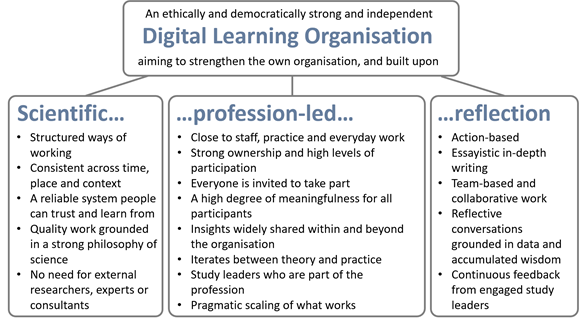
Figure 10.7. A summary vision for a digital learning organisation.
10.8 Who Is Actually an Inquiring Practitioner?
Who can actually call themselves an inquiring practitioner? Can you work in scientific ways without holding a doctorate or being employed at a university or college? The short answer is, of course, yes – absolutely. There is good reason here to issue a friendly warning against academic snobbery. Scientific rigour resides not in the title but in the way of working – how questions are formulated, how observations are made, how empirical data are collected and analysed, and how conclusions are drawn. Even if a classical research training naturally helps considerably.
It is also perfectly possible to study your own everyday practice without leaning on external experts, consultants or global IT companies. Some form of digital support is in practice necessary, but that does not mean that collected data must be sent halfway around the world to be analysed by an algorithm in the United States, far outside the profession’s own control. There are local, ethical, data-protected and practice-close alternatives.
But can you make a scientific contribution without being a researcher? Yes – it happens all the time. I have seen school leaders, lead teachers, social workers, coaches, managers and small business owners do this again and again through their work with DAS. One problem, however, is that their contributions rarely fit the classical format of academic publication. The structures for documenting, sharing and recognising proven experience from practitioner inquirers are still strikingly underdeveloped.
Can you count as an inquiring practitioner even if you do hold a doctorate? That is a harder question. There are many borderline cases that challenge easy answers. If you previously were in academic circles and then leave them to contribute to the world’s knowledge in other ways, are you then an inquiring practitioner? The answer probably depends on how we choose to define and interpret the concept. Cathy O’Neil holds a doctorate in mathematics but made her most influential contributions outside academia. Guillaume Chaslot completed a doctorate in computer science but then conducted his most significant inquiry as a private individual after leaving YouTube. Eli Pariser introduced the concept of the filter bubble without himself systematically collecting data. Are they inquiring practitioners? Perhaps.
Let us try to formulate a definition:
An inquiring practitioner systematically studies, through practical exploration, their own or others’ everyday practice with the aim of understanding, improving and changing it, WITH the support of documentation, reflection and analysis that is sufficiently rigorous to be shared and tested by others, but WITHOUT the support of academic titles, academic employment or other research structures.
Such a definition shifts the focus from hero inquirers and individual geniuses to everyday inquirers in entirely ordinary organisations. We need fewer exceptional individuals and more everyday inquirers who together build knowledge where the work actually happens. If this definition holds, then the answer to the question of who is an inquiring practitioner is considerably broader than traditional research structures allow. Academic researchers may dismiss us as quasi-scientific or semi-scientific practitioners if they like. We are proud all the same.
Because I have noticed that “inquiring practitioner” is a title that generates precisely that: pride. One manager began their emails to the leadership team about their everyday inquiries with: “Dear inquiring practitioners,”. The title creates a professional pride in entirely ordinary people by making visible that their everyday work is not merely being carried out, but also understood, developed and taken with the utmost seriousness.
10.9 How Do We Want to Study Our Profession?
In the end, the choice is ours. Do we want to hand over the study of our profession to global technology companies that treat us as raw data and keep their deepest insights about us to themselves? To academic institutions that observe our professional practices from a distance and then return with texts that few of us can read, let alone use? Or to state systems that bureaucratise everyday life and then, with a certain air of superiority, instruct us in how our work should be carried out? Or do we want to take responsibility for the inquiry and the decisions ourselves – there, in the everyday life where the work actually happens?
The question is ultimately about agenda and power. Whose questions should determine what is studied? Whose problem formulations should count? Who sits at the controls when data is collected, analysed and interpreted? Who makes the decisions, and how far above our heads are they made? If we do not make a conscious choice, someone else will make it for us. Power and responsibility then move away from the professions – often without us even noticing when it happens.
This book is now finished, and you are left alone with this choice. I am aware that becoming an inquiring practitioner can feel both demanding and uncomfortable. But the possibility is there now, at least. If you want to and dare to, you can start today. Begin an everyday inquiry in your own practice, with your colleagues, and much will become clear through learning by doing.