



The method DAS has so far been described as a way of working with clear components, processes and definitions. In this chapter, I take a step back and describe DAS through nine very different metaphors that have emerged over the course of the work. Metaphors are not primarily simplifications – they are tools for making meaning. They help us find our bearings in territory we have not yet fully mastered: “DAS is a way to take responsibility together”, “to strengthen the profession”, “to think more slowly”, “to write our way to wisdom”, “to sustain the energy for development”, “to ask better questions”, “to make the invisible visible”, “to train our judgement”, or “to cook nourishing ‘food for thought’ together”.
The metaphors take many different forms. DAS can be a kind of guilt-free moral system in organisations that otherwise get stuck in the question of whose fault something is. It can be a way for professions to reclaim ownership of their own development, beyond temporary projects and top-down initiatives. It can be a practice of slow thinking in environments that otherwise reward confidence, quick answers, and decisive action. It can function as a kind of everyday writing, or as an organisation’s critical conscience. It can represent a concrete craft for quality development work, a microscope that makes details visible, or a reflection muscle that needs to be trained over time.
These metaphors do not claim to be exhaustive or unambiguous. Nor are they intended as descriptions of how DAS is always experienced in practice. They function more as analytical lenses – different ways of looking at the same practice from different angles. Each metaphor illuminates something, but simultaneously obscures other perspectives. Taken individually, they are incomplete. Taken together, they form a broad interpretive framework for what DAS can be, do, and make possible over time. What they share is an attempt to capture DAS as human practice – not merely as scientific method.
9.1 DAS as a Moral System – But Without the Guilt
For many years I searched through theological literature looking for answers to what DAS fundamentally is. It was a difficult journey for someone like me, an agnostic. But eventually, among atheist theologians, I found perspectives that helped me understand more deeply why DAS can help us as human beings.
According to evolutionary biologist David Sloan Wilson, religions can be understood as social systems that increase group cohesion and thereby improve a group’s chances of surviving and functioning over time. In line with this, I see DAS as a secular equivalent – not as a doctrine, but as a moral system that strengthens professional collectives in their ability to hold together, learn and collaborate in complex environments. In his book Darwin’s Cathedral, Wilson writes about how such moral systems are vastly superior to hierarchical governance models built on rewards and punishment. People’s beliefs guide them towards behaviours that benefit the group, even when this occasionally comes at a cost to individuals. One of Wilson’s prime examples is sixteenth-century Geneva, which flourished under Calvinism. In a similar way, I believe that organisations working according to DAS principles can collaborate more effectively and develop their practice to function better year on year.
The philosopher Alain de Botton writes in his book Religion for Atheists that priests tend to describe human beings as forgetful, fragile and weak-willed. We so easily forget what we actually know to be right. De Botton (2012) argues that we are often far less wise in practice than our knowledge would suggest. That is why many religions have introduced rituals and annual cycles that regularly remind us of what we deep down believe and “know” to be right – Christmas (to be humble), Easter (to endure suffering), All Saints’ Day (to remember the dead), Sunday (to rest). In the same spirit, DAS can help us remember what it means to be a “good” colleague.
It is worth noting that DAS, in line with Schön’s “reflective practitioner”, seeks deeper understanding of what went wrong rather than absolution from guilt. We should learn from our failures, not moralise about them. But developing yourself and your workplace is still hard work – everyone wants development, but few want to be developed, as Figure 9.1 illustrates. Develop-ment work is therefore, at its core, a moral question, and DAS can become a supportive moral system within it. I remember the first time a group of teachers asked me to remind them every fortnight about the development work they had agreed to carry out together. At the time, I did not understand what they were asking for. Today I see it clearly: they were asking for a moral system – a rhythm that would help their development work weave more naturally into a hectic everyday life.
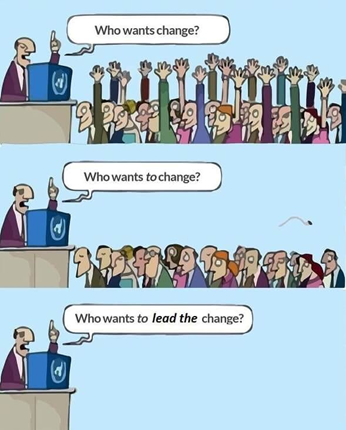
Figure 9.1 Classic cartoon illustrating the challenges of development work.
Read more:
de Botton, A. (2012). Religion for Atheists: A Non-Believer’s Guide to the Uses of Religion. Penguin Books.
de Botton, A. (2019). The school of life – an emotional education. Penguin books.
Gino, F., & Staats, B. (2016). Why Organizations Don’t Learn. Harvard business review, 94(1-2), 24-24.
Lackéus, M. (2021). Den vetenskapande läraren [The inquiring teacher]. Chapter 6.
Wilson, D. (2002). Darwin’s cathedral: Evolution, religion, and the nature of society. University of Chicago press.
9.2 DAS as Professional Stewardship – Because We Own Our Profession
If you own and live in a house, you look after it properly – you carry out ongoing maintenance and take on various improvement projects. The same is true of professions: they too need to be maintained and developed. You own your profession, and you spend a great deal of time inside it. Many others will claim to know how you should do your job. But you and your colleagues usually have the deepest understanding of what your professional everyday life actually involves. That is why you should also take the greatest responsibility for stewarding and developing your profession. But you need tools and methods. This is where DAS comes in – as a toolkit for professional stewards.
DAS makes it easier to take ownership of your profession, to feel genuine professional pride, and to find real satisfaction in its development. This is especially true when you compare it with the alternative: someone else coming in and knowing best how your job should be done. Unsolicited advice and top-down development work are common, but they can be draining. External researchers, politicians, consultants, managers, central support functions, self-appointed experts, public commentators – people who no doubt mean well but still often fail to help you in your actual professional practice. Imagine if they knew about DAS. Then you could work together on professional stewardship far more effectively. You and your colleagues lead the development work; they support it. Rather than the other way around.
Looking after a house is hard work. So is looking after a profession. There are many dimensions to develop – yourself, your colleagues, your organisation, your clients, as Figure 9.2 illustrates. Ideally, everyone should be thriving and at their best. And of course, outsiders should have oversight and be able to offer good advice and ideas. In complex professions, going it alone is rarely the answer. But when you have genuine agency and feel competent, the work tends to be more enjoyable and the results better. The joy and pride of looking after your own house is unmistakable in those who manage it well.
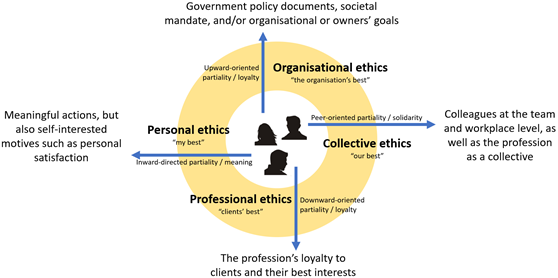
Figure 9.2. The moral arena of a profession. Revised from Fjellström (2006).
Read more:
Fjellström, R. (2006). Lärares yrkesetik [The Professional Ethics of Teachers]. Studentlitteratur.
Lackéus, M. (2021). Den vetenskapande läraren [The Inquiring Teacher]. Chapter 6.
9.3 DAS as Slow Questioning – Slowing Down to Ask the Right Questions
The psychologist Daniel Kahneman and the philosopher Friedrich Nietzsche both distinguish between two modes of thinking: the fast, intuitive and automatic – and the slow, reflective and effortful. Both are needed in everyday life, but many organisations prioritise speed and decisive action. The problem arises when fast thinking is allowed to dominate even in situations that call for careful consideration. DAS is designed to strengthen precisely those situations. We deliberately slow our thinking down from time to time, in moments when everyday life would otherwise push us towards hasty conclusions, overconfident oversimplifications, emotional laziness, and unconsidered solutions. DAS thereby elevates careful deliberation, critical analysis, deep reflection, uncomfortable truths, self-control, and the practice of pausing to think – sometimes called Apollonian “ordered” thinking, in contrast to Dionysian “intoxicated” thinking.
But where should we direct our thinking once we have managed to slow down? I have had a lifelong affection for what is known as Appreciative Inquiry (AI). This is an approach based on the idea that organisations change most effectively by systematically exploring and building on what is already working well, rather than focusing on problems and deficiencies. By asking generative questions about strengths, past successes and desirable futures, energy, shared learning and direction for continued development are created. Rather than taking the judgemental path (“whose fault is it?”), I recommend using our thinking pause to take the learning path (“what can we learn here?”) – drawing on what has worked well for us before. The questions we ask can genuinely change our lives. Figure 9.3 comes from the Appreciative Inquiry literature, and may be one of the figures that has influenced me most deeply.
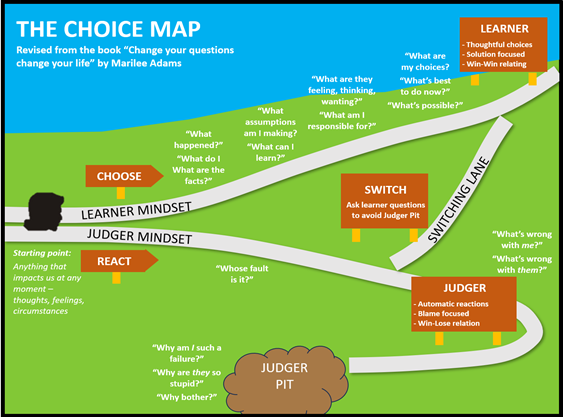
Figure 9.3. The choice you face in every difficult situation in life. Revised from Adams (2004).
Read more:
Kahneman, D. (2011). Thinking, Fast and Slow. Farrar, Straus and Giroux.
Nietzsche, F. (2000). The Birth of Tragedy. Oxford University Press.
Adams, M. G. (2004). Change your questions, change your life: 7 powerful tools for life and work. Berrett-Koehler Publishers.
Cooperrider, D. L., Whitney, D., & Stavros, J. M. (2008). Appreciative inquiry handbook: For leaders of change. Crown Custom Publishing Inc.
9.4 DAS as Everyday Writing – An Essayistic Tradition
In our eagerness to be efficient, we easily lose sight of deep thinking. I often hear the question: “who is going to have time to read people’s reflections?” My answer is usually this: if none of those who lead the organisation – whether formal managers or informal leaders – have time to read their colleagues’ genuine insights, then the problem is not DAS as a method. Then the problem lies elsewhere. The organisation has organised away its own learning. What we are seeing is not a lack of time, but a lack of curiosity about the organisation’s own practice, and a lack of long-term commitment to learning and analysis. The result is that action is prioritised over understanding and follow-through, and the same mistakes are repeated again and again. We do and do and do – but it is what the literary scholar Emma Eldelin (2018) calls a “living death”: thoughtless, lazy, blameworthy doing (pp. 61, 67). Sooner or later, the outside world punishes this harshly. In the private sector it can lead to bankruptcy. In the public sector it can lead to failed inspections. But the laziness of non-learning is unfortunately often allowed to continue for many years.
Through DAS, we write and read our way to wisdom in everyday life. Many write, some read and summarise, everyone analyses. I am often asked: “but how should we write?” My answer is that we need to write essayistically. The essay is an unusual but powerful literary genre, founded in the sixteenth century by the French philosopher Michel de Montaigne – see Figure 9.4 below. The French word essayer means to try: to attempt to write down a personal sketch of thought, rooted in personal experience. In silence, preferably in solitude, perhaps after a walk, ideally in a state of idleness. Restlessness sets our brains working at full speed on reflection. That is precisely why we tend to avoid it – many of us actually feel uncomfortable with idleness because it forces us to confront ourselves. But DAS helps us stop and meet ourselves, at least for a little while, from time to time.
Mellberg (2013) describes the essayistic approach as an alternation between detached stillness and active movement, anchored in both past experience and the concrete present, with an eye on the future. My experience is that in organisations where staff are encouraged to pause essayistically – to write short, concentrated essays of five to twenty sentences, which are then read and reflected upon by managers and leaders – people do not want to stop. It feels deeply meaningful. Time is found. The essayistic writing ability of staff develops quickly. Leaders want to read.

Figure 9.4. A page from Michel de Montaigne’s Essais with marginal annotations in Montaigne’s own hand. Montaigne (1533–1592) was the originator of the essay genre, and regarded essay writing as never finished.
Read more:
Eldelin, E. (2018). Att slå dank med virtuositet: Reträtten, sysslolösheten och essän [Idling with Virtuosity: Retreat, Idleness, and the Essay]. Ellerströms förlag.
Mellberg, A. (2013). Essä – urval och introduktion [Essay – Selection and Introduction]. Daidalos.
Pollan, M. (2018). How to change your mind: The new science of psychedelics. Penguin.
9.5 DAS as the Stone in Your Organisation’s Shoe – A Critical Conscience
The researcher Olof Hallonsten (2021) has written a book about the role and value of the social sciences in society. He summarises it as constituting the “critical conscience” of modern society, and identifies five key aspects of how working in scientific ways contributes. The aspects are: 1. Critical (“scrutinising prevailing conventions”), 2. Qualitative (“combating our over-reliance on quantification”), 3. Consequence-neutral (“not shying away from uncomfortable results”), 4. Demanding (“disrupting the established order in irritating ways”), and 5. Constructive (“contributing to dialogue and conversation”).
These five aspects map closely onto how we have seen DAS contribute to an organisation’s long-term wellbeing. On many occasions, DAS studies have led to frustration and disappointment when results did not turn out entirely as hoped. One example is the Swedish National Agency for Education, which has worked with DAS in various forms for over a decade together with me and my colleagues. Several of their studies have generated friction of different kinds – but also genuinely productive conversations. My role in those moments has been to facilitate dialogue and then respectfully document and publish the lessons learned in various research articles and books. We have also seen organisations that could not sustain this kind of uncomfortable learning process and chose to step away instead.
I find one particular metaphor in Hallonsten’s book especially apt: the idea that a scientific way of working can serve as an organisation’s “stone in the shoe” (p.183) – a disruptive presence with an important purpose. DAS helps us notice and question the prevailing order. It allows us to discuss various forms of harmful groupthink, established smokescreens, and simple but mistaken ideas, as Figure 9.5 illustrates. Strengthened analytical capacity and respectful dialogue then help build what Hallonsten calls an “antifragile” organisation – one that, like an immune system, is strengthened by challenges through careful, systematic learning. DAS becomes here a kind of mechanism for managing conflict: internal tensions are surfaced and can be discussed, “good” ideas can be sifted out and tested in practice alongside a wide range of less good – perhaps even “bad” – ideas that are systematically set aside, and in some measure fairly, because everyone gets to contribute in writing and in conversation.
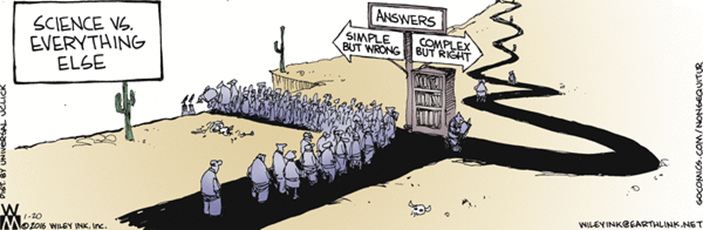
Figure 9.5. A classic cartoon showing science’s winding, unpopular path.
Read more:
Hallonsten, O. (2021). Modernitetens kritiska samvete: En samhällsvetenskap som gör nytta [The Critical Conscience of Modernity: A Social Science That Makes a Difference]. Santérus förlag.
9.6 DAS as a Quality Craft – One That Generates Pride
The development work of many organisations gets stuck in what has been called the “activity trap”. We carry out many development activities, but often without clearly understanding which of our own everyday needs they address or what effects they actually produce. Without thoughtful local needs analysis and systematic follow-through, development work easily reduces to activity: projects are launched, meetings are held, reports are written – but the effects never materialise. The activity trap closes around us for Dionysian reasons – we so badly want to demonstrate that we are taking action.
DAS can be understood as a remedy for the activity trap, by treating the DAS process as a quality craft that we carry out carefully and with pride at every significant development effort. When each step in the DAS process is handled properly as intended, it also becomes a kind of development brake for the organisation. We do not take on more development work than we can plan and follow up in a craft-like, robust way. Our development capacity may be reduced, but the effects of the development that actually takes place become visible.
In fact, our capacity may well be strengthened when we do fewer things more thoroughly and more responsively to real needs. We end up with development work we are prouder of. Proud not just of having done something, but of having understood in depth what we did, why we did it in that particular way, and what it led to in detail in our own specific context. DAS contributes here with language, structure, and rhythm for a quality craft that both holds up over time and feels more meaningful to be part of.
Seeing DAS as quality work has been common among practitioners over the years as the method has developed. One established framework for quality work is Deming’s PDCA cycle – Plan, Do, Check, Act, as shown in Figure 9.6. At the same time, DAS has grown out of a different tradition, with a stronger focus on learning, reflection, interpretation and professional judgement in complex everyday situations. The two approaches have clear points of contact, but also important differences. How they can best be combined in practice remains an open question.
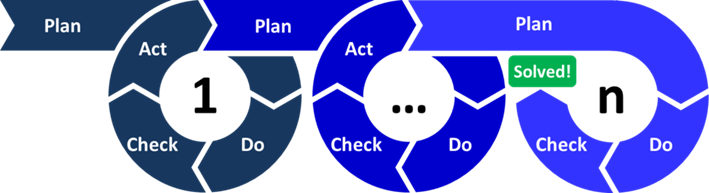
Figure 9.6 PDCA cycles illustrated by Christoph Roser at Allaboutlean.com.
Read more:
Katz, S., & Dack, L. A. (2013). Intentional Interruption: Breaking Down Learning Barriers to Transform Professional Practice. Corwin.
9.7 DAS as a Microscope – Making the Invisible Visible
Now we come to the metaphor that has been with us on the DAS journey the longest. The goal of making learning, knowledge and skills visible that would otherwise remain unseen has been with me in my research since the very beginning of my doctoral work in 2009. I wanted to make visible the powerful entrepreneurial learning I had experienced so strongly at Chalmers School of Entrepreneurship ten years earlier. It began as an unusual IT experiment, and eventually led to us building a digital “microscope” – Loopme – that made emotionally charged learning visible in new ways. What we were then able to see generated enormous engagement in many quarters – both the pedagogy (value creation pedagogy) and the methodology (DAS).
Our new microscope was taken up each year in more and more unexpected places. Many others seemed to have felt the same frustration about learning that was hard to capture or had been rendered invisible. The microscope was tried in vocational education, leadership, early years settings, hospitality, strength training, healthcare, and more. Everywhere there seemed to be powerful learning, deep expertise, and important effects that had previously never been made visible.
Today I think the word that best captures the microscope effect is not “Loopme” but “micro-reflection”. When we ask participants to reflect in depth on very precisely defined questions or actions, the quiet knowledge of everyday practice is captured – along with the emotional learning that is so hard to pin down. Each micro-reflection contributes like a pixel to an increasingly high-resolution image that becomes clearer and clearer as you zoom out. We often say that DAS is a bit like the arrival of colour television. In a well-conducted DAS study, the wow effect can be experienced in a similar way. Black-and-white learning without reflection becomes full-colour learning with reflection. We therefore like to joke that if repetition is the mother of knowledge, then reflection must surely be its father.
When micro-reflection is added to the learning process, we see more deeply what is happening and what people are learning. Micro-reflection on feeling, thought and action makes people’s knowledge and skills visible, as Figure 9.7 illustrates. Previously, we had assessed knowledge through written responses (tests and exams) and assessed skills through action (so-called portfolio assessment). What was new here was the repeated capturing of feeling in the moment through micro-reflection. Learning processes that had previously been invisible became visible.
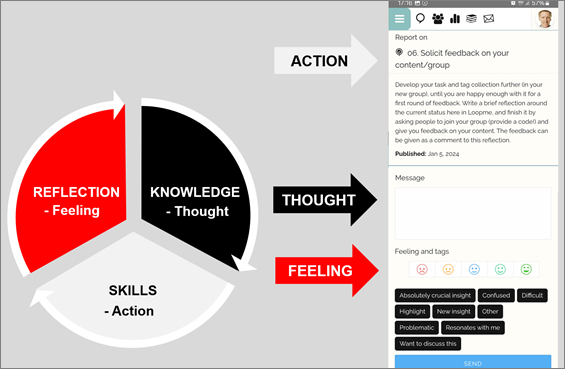
Figure 9.7. DAS makes knowledge and skills visible through feeling-based micro-reflection. Example task from my everyday inquiry training.
Read more:
Lackéus, M., & Sävetun, C. (2025). Designed Action Sampling as a new research method to help build active communities in entrepreneurial education. Entrepreneurship Education & Pedagogy 8(2), 206-239.
9.8 DAS as a Reflection Muscle – Training Our Judgement
No one expects to become strong without training, yet when it comes to reflection and professional judgement, we rarely think in those terms. The historian of ideas Sverker Sörlin (2019, p.90), in his book In Defence of Bildung, asks how one develops good judgement. He then quotes François de La Rochefoucauld, who wrote as far back as 1664: “Everyone complains of their memory, but no one complains of their judgement.” I think of our capacity for reflection as a muscle that needs to be trained. When we become strong at reflection, what we gain is precisely good judgement – and that judgement then helps us make wiser decisions in everyday life.
With DAS, we train together. We practise writing down insights. We highlight particularly wise formulations. We test our interpretations and talk them through. Analysis is not a one-off event but a judgement skill that is gradually refined. And just as with strength training, regular visits to the gym are required – ideally every week.
Training reflection and judgement is also a leadership responsibility. Study leaders do not build others’ good judgement by doing the heavy lifting themselves – by telling people how to think. Instead, they create moments in everyday life where wise thinking can take place.
The connection to essayistic writing is clear here too. Putting your thoughts into words forces precision and careful consideration, and strengthens your ability to articulate the quiet knowledge of everyday practice. Over time, skill and a shared language for wisdom are built up. We become increasingly good at recognising good judgement – and at developing it further.
Read more:
Sörlin, S. (2019). Till bildningens försvar [In Defence of Education [or rather: Bildung]]. Natur & Kultur.
9.9 DAS as Home-Cooked Food For Thought – From Restaurant Visits to Your Own Gourmet Kitchen
Another way to understand DAS is through a cooking metaphor. In development work, we need food for thought – the accumulated nourishment of ideas, research, experience and professional insight that sustains the development of our practice. I have been inspired here by the notion of “spiritual nourishment” – the intellectual and moral sustenance we receive through literature, learning, conversation and lived experience. Advice, models and methods can then be seen as different kinds of food for thought: prepared somewhere, served in different ways, and – hopefully – digested in our own organisations.
When it comes to developing our practice, we face several choices: 1) Who cooks the food – who gives us advice? 2) Where is the food delivered – where is advice created, handed over and discussed? 3) How is the food consumed – how does the practical application of advice actually work? And 4) How nutritious is the food – how do we know whether the advice works for us? The answers to these questions have consequences in terms of cost, agency, impact, time and staff involvement. Four possible answers are shown in Figure 9.9.
Going to a “restaurant” means attending conferences and expert-led events. The food for thought may be sophisticated and well-prepared – but how much of it is actually digested once we return home? How much is left uneaten? “Takeaway” means bringing ideas home from books, courses or distance learning. Some find this inspiring; others find it difficult to relate to their own context. A “potluck” involves practitioners sharing their own experiences with one another – a collective table of ideas, uneven perhaps, but often grounded and relevant. The final category – “home-cooked” – is where DAS comes in. Instead of consuming someone else’s food for thought, professionals are invited to prepare their own, together, within their own context. As I have often heard leaders say: “we already have the expertise we need.” Where that is true, DAS offers a way to turn that expertise into nourishing, locally grounded food for thought – often at a fraction of the cost of external solutions. Or you can combine them.
This metaphor makes responsibility and ownership visible. In DAS, there is no distant chef in an industrial kitchen. Those who prepare the food for thought are also those who will live with its consequences. It also reminds us that good nourishment takes time. Calories can be rushed, flavour cannot. In the same way, development activities can be produced quickly, but wisdom and judgement takes time to cultivate – like locally sourced, carefully prepared food for thought. It’s a bit like slow food but for organisational development. It is less about consuming ready-made ideas and more about cultivating one’s own insights.
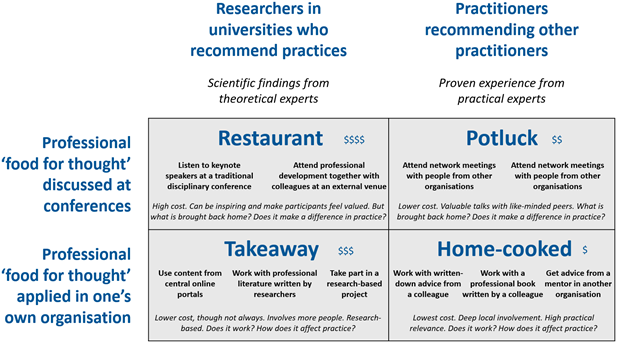
Figure 9.9. A four-quadrant model using a cooking metaphor to illustrate four different ways of organising development work (Lackéus, 2024).
Read more:
Lackéus, M. (2024). Hur kan skolledare i utsatta områden få hjälp? Tre etablerade sätt och ett nytt arbetssätt [How can school leaders in disadvantaged areas be supported? Three established approaches and one new way of working]. Unpublished essay written for the Swedish National Agency for Education, available on request from the author.