



Designing action tasks and tags is the starting point for the entire DAS process – this is where the foundation is laid for both engagement and quality in everything that follows. The design work begins by formulating an inquiry question – a question that feels genuinely urgent to find new answers to. A topic that chafes, engages, or sparks curiosity. It might be a recurring challenge at work, relationships that aren’t working as you had hoped, something that works well on a small scale that you want more of, or perhaps a new way of working that you want to understand better. For DAS to work, this curiosity needs to be translated into small, testable actions – action tasks – that others can carry out and reflect on.
This chapter is about that translation. How you move from an idea to an action task and tag design that both engages participants and generates meaningful data for analysis that can make a difference for everyone involved. In this chapter, you will therefore get support in designing the three most central parts of the entire DAS method – the inquiry question, the action tasks, and the tags. Together, they form the heart of every DAS study, and determine how easy and meaningful it feels for others to contribute, how deep and interesting the reflections become, and how useful the patterns that emerge in the analysis will be.
Working in research-informed ways follows a certain workflow, see Figure 4 below. First, we introduce our topic – what is the actual purpose? What is the key question we want new answers to? Why should we even care? Then we look at what humanity already knows about this topic – what we call theory and literature. It would be foolish not to even look, to reinvent the wheel. After that comes methodology, in this case DAS. When the methodology has been put into practice, we get an outcome – a certain amount of collected data, or findings. We analyse and discuss this outcome, and finally we try to connect back to our starting point. What have we learned now? The arrows in the middle of Figure 4.1 also show natural connections between the different parts. Conclusions should link back to the introduction. The discussion should be grounded in what humanity already knows. The findings are a consequence of the chosen method.
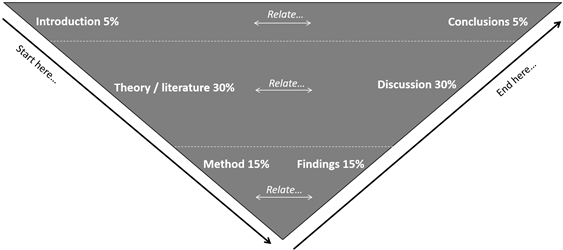
Figure 4.1. Structure for research-informed work. Figure inspired by Professor Helle Neergaard at Aarhus University in Denmark.
4.1 From Curiosity to Inquiry Question
An inquiry question is rarely born at the desk. It grows from a feeling. Perhaps that something chafes, that something works unexpectedly well, or that you sense a connection you don’t quite understand. In DAS, we call this the beginning of an everyday inquiry – an everyday attempt to study and understand when, how and why things turn out the way they do.
Shaping an inquiry question is like directing a spotlight. You choose what you want to illuminate, what you want to know more about, and what is actually possible to explore within the scope of your work. Most of us find ourselves in what I call the everyday inquiry zone. We can’t dedicate four years full-time to research, but we do want to work a bit more systematically with learning in everyday life. It’s therefore about inquiring rather than researching – making it possible for more people to understand their own practice in depth, without having to leave it.
An inquiry question becomes the starting point for that work, see Figure 4.2 below. It helps us stay on course when everyday life spins on. Without a clear question, it’s easy to get lost, to start collecting reflections just because it’s interesting. The inquiry question is like an anchor that keeps your everyday inquiry in place, that pulls you back to the starting point when the wind blows.
The question doesn’t need to be complicated. Quite the opposite. The best questions are often the simplest. They might start with “how can we…” or “what happens when…” or “why…”. A good question sparks curiosity, and feels important not just to you but to several people around you. When colleagues spontaneously say “yes, I want to know that too!” – then you know you’re close to something that has traction.
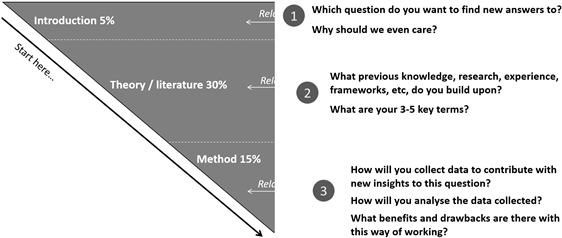
Figur 4.1. The starting point for an everyday inquiry – inquiry question, literature and method.
Read more:
Lackéus, M. (2021). Den vetenskapande läraren [The inquiring teacher]. Chapter 1, 11.
4.2 A Strong Inquiry Question – Some Characteristics
There are several characteristics of a strong inquiry question, see Figure 4.2 below. Your question should be answerable with the data that DAS collects – reflections, feelings and tags that indicate effects. Otherwise, DAS isn’t suitable for seeking answers to this particular question. Also make sure your inquiry question specifies what you want to study. If you want to study colleagues’ learning, make sure that’s clear in your inquiry question. Avoid yes/no questions. Few questions are interesting in the long term if they can be answered with yes or no. Also try to focus on a single topic or main problem, otherwise it easily becomes scattered.
The best questions are often simple in form but rich in possibilities. Try to make your inquiry question immediately comprehensible and clear. Perhaps by testing it on others. Do they understand without you explaining? Does the question feel important to more people than just yourself? Try to connect to relevant literature. Perhaps an author you like has written about this and thereby confirmed that what you’re wondering about is an important continuation for the field as such. Also try to work with questions that can contribute to that very field, if we find good answers. It’s always more enjoyable to work with something that feels relevant to a broader circle.
But don’t forget the heart. An inquiry question that doesn’t mean anything to YOU won’t hold. It’s the engagement that carries you through all the things that take time – reading, reflection, analysis, waiting for responses. That’s why you need a question you really want answers to. A question you can bear to read a hundred reflections about. Otherwise, you probably won’t manage to be as structured and persistent as you need to be to work in research-informed ways. Try to work with something that matters to us as humans.
When you have such a question – urgent, possible, meaningful and human – you have everything you need to move on to the next step: translating the question into actions.
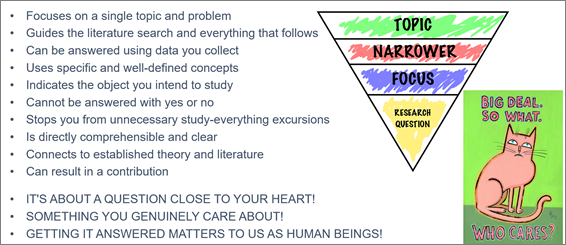
Figure 4.2. Characteristics of a strong inquiry question.
4.3 From Inquiry Question to Action Task Ideas
When the inquiry question feels stable, the next step is to let it meet reality. Here, thought is translated into action – a movement that is central to the entire DAS methodology. An inquiry question specifies WHAT we want to understand, while the action tasks formulate HOW we will understand it through testing. Have conversations with colleagues or other intended participants in your DAS practice study. Ask them to describe situations where your inquiry question comes alive. What moments, routines, actions or meetings lie at the heart of what you want to investigate? From these stories, ideas for small tests often grow – actions that can be tested directly in everyday life. Involving colleagues in action task design also creates ownership in the work.
You can also be inspired by others’ action tasks, even if they might be about a completely different inquiry question. In the task and tag library at www.library.loopme.se you’ll find many action tasks you can draw inspiration from. Browse around and see what ideas you get.
A good action task is concrete but not too narrow. It should be possible to carry out, but at the same time open to interpretation. If it’s too loose, it becomes difficult to see patterns in the analysis; if it’s too controlled, it becomes mechanical. Try to create structure without stifling curiosity and engagement. Base it on Kolb’s learning cycle: plan – act – feel – reflect. Ask yourself: what do participants need to do and then reflect on for us to get new answers here? Look for action task ideas that trigger both emotions and learning. The action task is the cause that we then hope will lead to effects of interest, see Figure 4.3 below.
After a while, you can start choosing. Save what is concrete, emotional and meaningful. Five to ten action tasks are enough for a first everyday inquiry. Together, they should ideally cover different angles of your inquiry question. This becomes your first action task design, ready to be refined. Some of the action tasks might be for all participants to try, other action tasks can be optional depending on context, interest and needs.
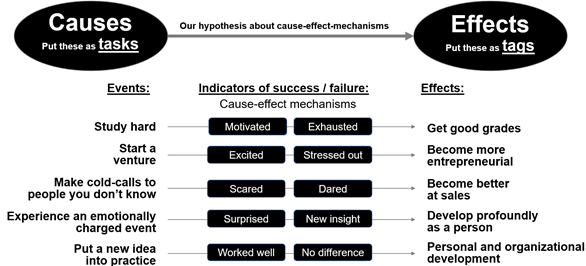
Figure 4.3. The difference between tasks and tags in DAS.
4.4 How to Build an Action Task Description: Title, Action, Reflection
An action task is a design in miniature – a planned reflective action. It’s not just about doing something, but about creating a microscopic learning experiment where action, feeling and reflection form a whole. The action task should be able to take the participant through Kolb’s entire learning cycle. It begins with a planned action: they do something concrete in their everyday life that requires more or less planning. The action should ideally be emotional – engagement, hesitation, joy, risk-taking, frustration – because emotions trigger learning. Finally comes reflection: what happened, how did it feel, and why do they think it turned out that way? See Figure 4.4 below.
A well-formulated action task begins with a verb in the title: Do, Try, Discuss, Explore, Develop, Suggest, Ask, Create, Imagine, Call, Contact, Begin, etc. The verb signals action and possibility.
The action task should ideally be an invitation to exploration, not “just” an instruction to follow. Tone matters. The description should breathe courage and curiosity, not control. Therefore, add more reflective questions in depth, directly in the action task description: “What surprised you?”, “What do you want to try next time?”, “What new insights did you gain?”. Such questions lead to more interesting and deeper reflections.
Think in terms of “constructive alignment”. This is about the interplay between the study leader’s intention, the participant’s activity, and the effects one hopes for. An action task should therefore not only be engaging and possible to carry out, it should also be logically connected to the inquiry question you want to understand more about. By thinking about expected effects – in the form of feelings and results – already in the design moment, you create action tasks that contribute to the analysis later on.
Read more:
Lackéus, M. (2021). Den vetenskapande läraren. [The inquiring teacher] Chapter 6.
Biggs, J., & Tang, C. (2007). Teaching for quality learning at university. Open University Press.
4.5 Designing Tasks That Lead to Deep Reflection
Deep reflection doesn’t happen by itself. It must be invited, awakened, guided. When we ask participants to reflect in DAS, we need to think about both what they should reflect on and how they are asked to reflect. A reflection becomes interesting only when it moves beyond a description of what happened toward an understanding of why it happened, what it awakened in them, and what can be done differently next time.
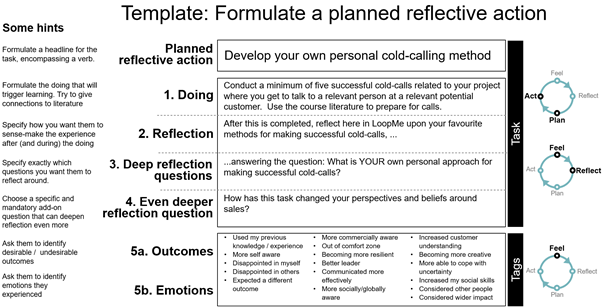
Figure 4.4. Template for action task design with an example action task.
Forty years ago, the researcher Donald Schön described the reflective practitioner as someone who learns by thinking in action. Reflection transforms experiences into professional knowledge. Therefore, reflection is not an unnecessary addition to the work – it is the work’s most learning-rich part. DAS actively helps participants become better at precisely this, so they can more easily see connections, discover patterns, and understand themselves in their work. In every action task description, there should therefore be two to three probing questions, see Figure 4.5 below.
Gently but firmly, we push participants to think deeper, to pause before their own hidden assumptions. You can also ask them to relate to something bigger: a theory, a value, another person’s perspective, something that surprised them. An interesting reflection moves from event to insight, from vague feeling to deep understanding. Our task as study leaders in DAS is to design an action task description that makes that movement possible.
Written deep reflection requires safety, dedicated time and a study leader who reads and responds confidentially. When participants then notice that their thoughts are taken seriously, they dare to open up and deepen their thinking. Most people also need to practise written reflection. In the beginning, answers might be short, but after a few action tasks, a clear deepening is often noticeable. Reflection is like a muscle – an ability that grows with use – read more about this metaphor in Chapter 9.
Read more:
Chan, C. K. Y. (2022). Reflection as assessment in experiential learning. In C. K. Y. Chan (Ed.), Assessment for Experiential Learning (pp. 160-191). Taylor & Francis.
Lackéus, M. (2021). Den vetenskapande läraren. [The inquiring teacher] Chapter 7.
Schön, D. A. (1983). The Reflective Practitioner, How Professionals Think In Action. Basic Books.
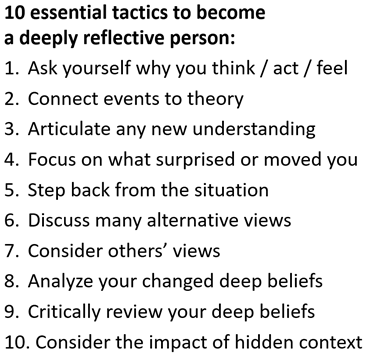
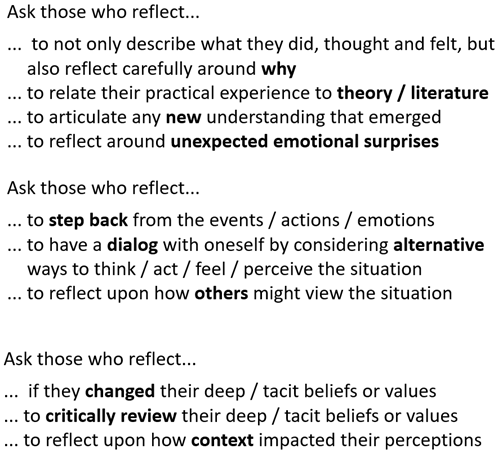
Figure 4.5. Some strategies for achieving deep reflection among participants.
4.6 The Thinking Behind Tag Design
The purpose of tags is twofold: they should both support the participant’s reflection and facilitate analysis. For the participant, they function as mirrors that help put words to what happened: “Did I feel courage?”, “Did I see results?”, “Did I get a response?”. For the study leader, the tags create order in large amounts of text, making it easier to analyse the material.
When tags are designed, the DAS study’s language for cause and effect is shaped. Therefore, always start from your inquiry question and ask yourself which effects, indicators and feelings – if captured repeatedly – can actually provide answers. Tags help us see the mechanisms at the micro level that likely link a certain effort to a certain result, see again Figure 2.8 in Chapter 2. Here, the tags function as small hypotheses about effects. They help participants quickly report how it went, so that you as study leader can more easily see patterns.
Start close to practice and use words that participants spontaneously understand. Avoid theoretical concepts that require interpretation. Create tags based on the goals, indicators or positive characteristics that are relevant to you. Also let negative tags take some space – what was absent, what chafed, or what went wrong. Then both progress and friction become visible, which makes the analysis sharper. Also strive for just-right granularity. Tags that are too coarse tend to swallow everything; too narrow ones are never used. A tag should be one to five words and grounded in everyday language.
Also think composition. A good set of tags captures both effects and emotions, because it’s precisely the interplay between results and feelings that often reveals the mechanisms behind them. When an action is repeatedly tagged with “Courage”, “Good response”, or “Big difference”, a mechanism begins to emerge. Tags are also living material – they can develop as data flows in, until they capture more and more relevant aspects. A reasonable number of tags is between 10-25. Categorise them by putting a letter before each tag that stands for something, for example “M: ” for effects on the participants themselves (“Me”-tags), and “C: ” or “S: ” for effects on customers or students.
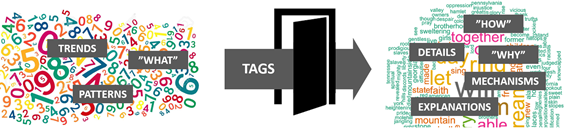
Figure 4.6 Tags in a DAS study are like a door between numbers and text.
Read more:
Lackéus, M. (2021). Den vetenskapande läraren. [The inquiring teacher] Chapter 7.
4.7 The Value of Tags in an Everyday Inquiring Community
When a group of people design, use and analyse tags together, something more than data collection happens – a community grows. The tags become a language for collective exploration, a way to put words on what is otherwise only sensed. Creating tags is therefore not just a methodological question, but also a cultural process.
When you formulate tags together, it becomes the first step toward building a community of reflection. By trying different words and expressions, the group begins to talk about their work in new ways. The discussion about which words fit best creates shared understanding about what counts as important. The collective learning begins here already.
When participants then start using the tags in their reflections, a common language for experiences and results is established. Participants see what’s available to choose from, which influences their reflections but also their actions going forward. The tags also help the group share feelings and discoveries in a safe and structured way. This builds community, recognition and meaning.
In the analysis phase, the tags finally become a shared map of learning. The group sees their own patterns emerge: when courage increases, when frustration arises, what seems to create energy or resistance. This sparks conversations that would not have happened otherwise. The tag outcomes function as a mirror of collective learning – not as truth, but as an invitation to deeper interpretation. Because it’s important to remember: tags don’t give final answers about what works. They are not proof, but indicators – small signals about where to direct your qualitative curiosity. Their value lies not in exactness but in how they lead onward to conversation, understanding and shared meaning, see example in Figure 4.7.
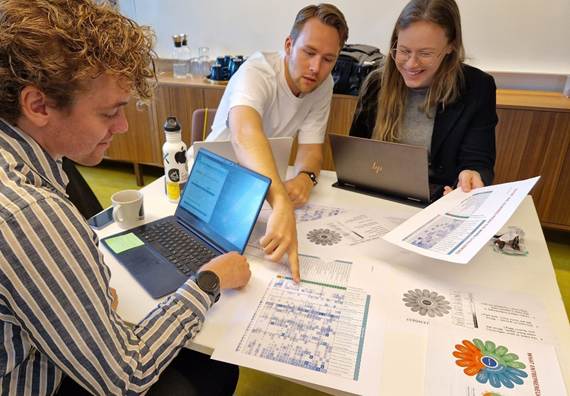
Figure 4.7. Image from a meeting where participants interpret the meaning behind different tag outcomes, read more in the blog post below.
Read more:
4.8 Growing with Your Design – Action Tasks and Tags in Constant Development
A DAS study is never finished. Each round is a new prototype, a chance to learn and refine, see Figure 4.8 below. Action tasks and tags are living components that need adjusting when people start using them. The best design emerges through repeated small iterations – by testing, observing, adjusting and testing again. Perhaps over several years if it’s an important enough question.
When you’ve designed a complete set of action tasks and tags, ask for feedback. Let three to five people comment on formulations and perhaps test the action tasks and tags before you invite all participants. Small adjustments in word choice, length or tone can make a big difference for engagement and meaningfulness. You can also ask for feedback from someone with long experience of DAS, perhaps outside your own organisation. Perhaps even from us who developed DAS as a method.
Make sure the action tasks and tags really connect with the inquiry question. Also adapt the rhythm to the organisation’s calendar. How many action tasks are just right over how long a time? Which action tasks should be time-bound with deadlines, which should be optional in time?
During the study, you will get new ideas through participants’ reflections, things you hadn’t thought of. Dare to change action task descriptions and tags as you go. Gather feedback from participants about clarity. When the analysis begins to show patterns, let the insights feed back into the design. Test action tasks in different contexts, regard the variations as data.
End each study by writing down what you’ve learned about the design: which action tasks and tags worked, which lost energy, and why? In this way, each iteration becomes not just a study – but a new level of understanding about how development actually happens.
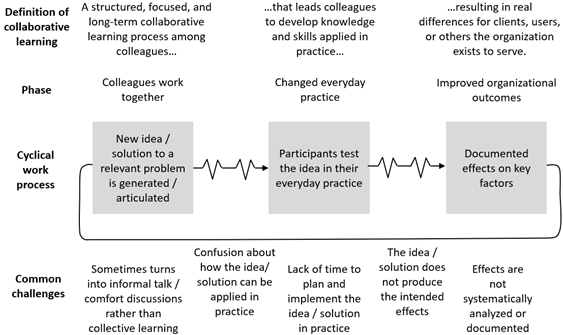
Figure 4.8. DAS is a cyclical and collegial process with the purpose of improving practice.
Read more:
Lackéus, M. (2021). Den vetenskapande läraren. [The inquiring teacher] Chapter 3.
4.9 Designing Meaningfulness into Your DAS Study
Designing action tasks is about asking other people to do something. It’s an invitation to action, but also a risk, see Figure 4.9 below. If the action tasks feel irrelevant, moralising, or like unsolicited advice, they quickly lose their power. That’s why it’s absolutely crucial that every action task is experienced as meaningful – both for the person carrying it out and in their environment.
One way to create this meaningfulness is to design action tasks that lead to something of value happening for others than the participants themselves. Asking people to do something that improves something for another colleague, a customer, a user, a student or the organisation as a whole often awakens positive feelings and engagement. When participants get to contribute to something that becomes noticeable to others, pride and responsibility arise, feelings that drive deep learning. It also creates emotional resonance. When you succeed in helping others, you often feel better yourself.
At the same time, it contributes to ethical sustainability. When action tasks do good for more people than those who participate, the everyday inquiry itself becomes a value-creating process. It doesn’t feel like an unnecessary study that is “done to” people, but like a joint improvement effort that everyone benefits from. In the long run, DAS is about precisely this: helping an organisation understand how it can succeed better with its ultimate mission and overarching purpose. When the action tasks are experienced as contributing to this – to something real and genuinely important – the feeling of burdens and unsolicited advice disappears. Then the inquiry instead becomes a meaningful way to create value, together.
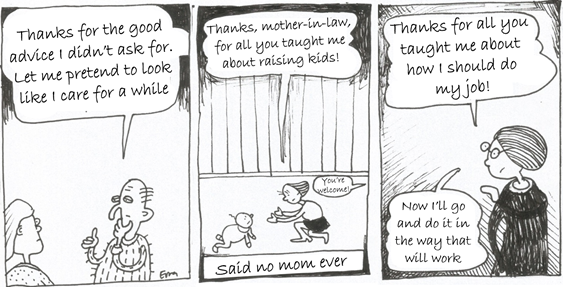
Figur 4.9. Three cartoons by cartoonist Erik Johannson illustrating the risks of giving people unsolicited advice (Lackéus, 2021, p.101).
Read more: Lackéus, M. (2021). Den vetenskapande läraren. [The inquiring teacher] Chapter 6.