


Now we come to one of the most beautiful aspects of everyday inquiry, but perhaps also the most challenging. That moment when we, as study leaders, invite a larger group of participants to carry out various actions we have designed for them, and then reflect on what they learn from it. We call this practical work a kind of Digital Datadriven Dialogue (DDD), because we invite a dialogue that takes place primarily digitally and thereby generates high-quality empirical data that we can then analyse together. The beauty lies in capturing moments of deep human insight, in spotting patterns that can make a difference for many, and in creating collective learning that sparks energy, builds community and creates trust. We get wiser decisions and more grounded change.
Leading an everyday inquiry is fundamentally a leadership task, a role that evokes feelings of all kinds – pride but also uncertainty, inspiration but also confusion, familiarity but also loneliness. It’s about leading others’ learning – a different kind of leadership compared to leading production or other everyday tasks. It’s a role that sits somewhere between manager and employee. Sometimes the role is called middle leadership, which illustrates something of a dilemma. The role of learning leader is absent from most organisational charts, yet is informally carried out by many. This is an inherent ambiguity that makes everyday inquiry challenging to get started in many organisations. So-called imposter syndrome is common. Who am I to take on the leadership of others’ learning?
Should it be the formal manager who takes on the role of learning leader / study leader / middle leader? Perhaps, but not necessarily. It can actually be an advantage not to be the participants’ formal manager, as they may then feel a little more relaxed and write a bit more openly and honestly about challenges and problems they experience. Which is often where the learning is greatest. At the same time, there are many leadership styles that fit well with everyday inquiry, for example transformative or coaching leadership, which focuses on engagement, meaning and personal development, see further in chapter 7. What we often see in practice is that the formal manager gives a close colleague the task of leading the inquiry.
Everyday inquiry is built on many people reflecting often and briefly, ideally in direct connection to a completed action. As we’ve already touched on in chapters 1 and 2, a digital tool like Loopme is therefore a prerequisite for everyday inquiry to work in practice. In this chapter we turn to how this partly digital “interplay” works in practice.
5.1 IT Tool for Datadriven Dialogue: The “Ball” That Makes a New Practice Possible
The digital interface functions as a research platform in miniature – a place where everyday dialogue and science meet. That’s why we call what we do Digital Datadriven Dialogue, a concept coined by Per-Erik Holmén, development manager in Skåne in southern Sweden. He wanted to put words to the work we did together in the digital space.
A tool like Loopme is fundamentally a democratic platform. All participants get equal space, all voices are visible in the data, and every reflection is stored structured according to action tasks. The study leader can then work calmly and persistently. Follow their flow of reflections, respond as quickly as possible and simultaneously build a shared analytical foundation that the group can return to over time.
You can view everyday inquiry as a new kind of “ball sport” we have invented – and which many seem to enjoy. Everyday inquiry is a partly digital team game where action, reflection, data and dialogue merge together. Some formulate actions, many try them out, everyone learns together by writing, reading and interpreting. It’s science that touches the heart – a shared experience of interplay rather than a dry method.
In this game, Loopme is our “ball”. It’s the ball that makes the interplay possible and holds the whole together. A good ball must be light, responsive and reliable, so that reflections can fly back and forth without losing momentum. When the ball works well, it’s barely noticed – it doesn’t disturb the game, it carries it.
Behind this seemingly simple “ball” lie years of careful “stitching” through design, programming, testing and adjustments. Every function – action tasks, tags, feelings and comments – is like seams in the leather, each one necessary for the whole to hold its shape. When the ball is well-stitched and well-pumped, something often described as magical emerges: the game flows, people learn, and data begins to speak.
The sports metaphor used here is drawn from Couldry and Hepp’s (2018) description of how deep meaning arises in lived contexts characterised by a meaningful purpose, clear roles, relationships, technical support, emotions and mutual dependencies (see figure 5.1).
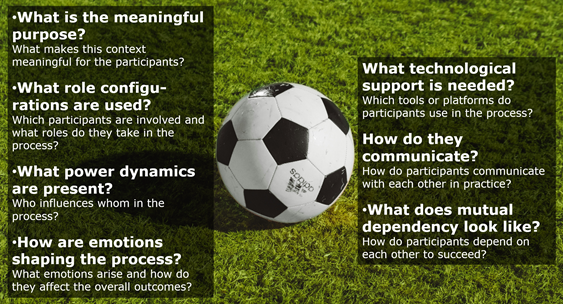
Figure 5.1. – The IT tool is the “ball” that enables a new shared “sport” we call everyday inquiry. Concepts in figure drawn from Couldry & Hepp, 2018, pp.63-78.
Read more:
Couldry, & Hepp (2018). The mediated construction of reality. John Wiley & Sons.
5.2 Configuring an Everyday Inquiry in DAS
The first thing the study leader does in the IT tool is to start a group for shared action-based reflection. The group can be “hierarchical” – only the study leader(s) can read participants’ reflections, or “flat” – everyone can read each other’s reflections, see Figure 5.2. A hierarchical group creates a more confidential and relational feel, while a flat group can create greater engagement because there is more activity in the group that each participant can take part in through the social feed. It’s also possible to have two groups in parallel – a hierarchical group for the more confidential and personal learning, so that participants dare to write also about what hasn’t gone well, and a flat group for collective learning and analysis in more general terms.
The study leader first configures their new group with the action tasks and tags designed for the purpose, and then invites all participants to go in and read the action tasks and reflect when they have completed them. In Loopme there is a library of ready-made action tasks and tags, the so-called content packages. Such a package can be imported into a newly created group. After import, you then choose which of all the action tasks should be visible to participants. You can also edit each action task. In larger studies I usually create my own content package with a shared set of action tasks and tags that I then import to several different groups. Then I can analyse outcomes for all groups combined, which is powerful and time-saving.
If participants are unfamiliar with everyday inquiry, it can be good to have a very first action task that invites to pure reflection. It might be about expectations, about introducing yourself, or reflecting a bit initially on the inquiry question that will be explored together.
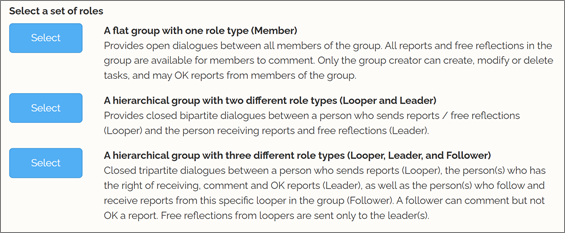
Figure 5.2. This is what it looks like when you choose which group type you want in Loopme.
5.3 Introduce the Inquiry Clearly: Purpose, Why, How
The first time participants are invited to an everyday inquiry, some things need to be explained. Why should we even reflect together? What is the overarching meaningful purpose? What benefits do we expect from this? How long will the inquiry last? Why do the action tasks and tags look the way they do? What effects do we want to see? How much time will this take?
Do tell them that everyday inquiry is not about measuring or assessing, but about learning and developing the organisation together. Also tell them about your inquiry question, how it came about and why it matters. Explain the three steps in everyday inquiry – design, action and sampling/analysis, perhaps with a simple figure. Explain that together you will try out, reflect, read and analyse, and that learning happens all along the way, not just at the end. If participants have been involved in designing action tasks and tags, it also becomes easier to create engagement now that the inquiry is launched for real.
It can feel scary to introduce a new digital tool that requires registration and login. At the same time, our experience is that an IT tool like Loopme is a smaller threshold for participants than much else in an everyday inquiry. It can be good not to make too big a deal of the IT tool itself, but instead put the main focus on the meaningful purpose of systematic individual reflection and feedback. There will always be people who complain about IT regardless of design, because IT is a common source of irritation in people’s lives. We must respect that, but just don’t let it take up too much space.
Do set aside 15-20 minutes at a meeting to reflect together in silence on the very first action task, which can consist of pure reflection. Then you can walk around and help those who may have got stuck with login and other IT troubles. It can also work well to email a link to all participants a few days before a meeting, and then they can on their own register, get in and do their first reflection in peace and quiet. In an email, however, it can be harder to explain the purpose properly. Do it verbally as soon as the opportunity arises.
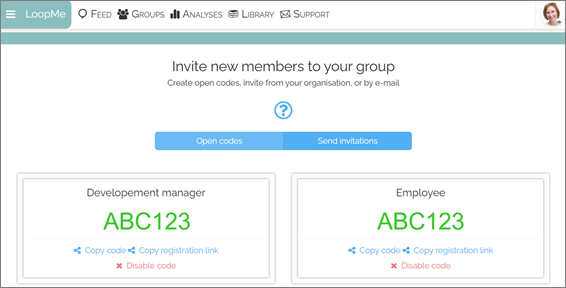
Figur 5.3. Under the “Members” tab on your group in Loopme you can invite participants. If you want to invite other study leaders who will lead participants’ learning, choose the code or link on the left. If you want to invite participants, choose the code or link on the right.
5.4 The First Weeks – Feedback, Pace, Deadline
Now that your participants have been invited to a group, data collection has begun. The first weeks create their first impression, and then it’s extra important to be active. As soon as you’ve received some reflections, give some feedback. If questions come about the study or methodology, answer quickly. If someone has problems logging in, help them if you can. If you’re using Loopme, remember that they have a support desk that can quickly help new users with problems.
Feedback should be given quickly, ideally within 1-2 days, because tempo signals that the reflection is valuable. When several study leaders share the responsibility, you can take turns responding, but the tone should always feel human, curious and respectful. Write as you would speak to a colleague you respect – personally, encouragingly and with focus on learning rather than performance. I usually pick up on some specific detail in the participant’s reflection, and develop my thoughts around that particular detail in a personal way. Sometimes I ask a follow-up question, especially if my curiosity has been awakened in relation to my inquiry question.
Early on it’s also good to be responsive to the pace in your inquiry. Have participants been given enough time? Are the action tasks coming at the right pace and order? Do action tasks or tags need to be revised based on new insights you’ve gained since the start? In Loopme there is also a participant-task matrix where you see which participants have done which action tasks, see Figure 5.4 below.
Has everyone received a comment? Every green tick in the matrix should have a little speech bubble under it, then they’ve received a comment. If you see that some participants are falling behind in the action tasks, do get in touch with them and ask if they need help. A red dot in the matrix means that the reflection was submitted after the deadline, if one is set. It’s good to set deadlines on action tasks, because then reminders are sent out automatically. But it’s not always appropriate with a deadline, you don’t always know when in time an action task can be completed. Nor is it appropriate with a deadline on optional action tasks.


Figure 5.4. Under the “Tasks” tab on a group in Loopme you’ll see the following participant-task matrix.
5.5 Give Participants an Analysis Overview Early
The earlier you as study leader can offer all participants an early overview of their reflections so far, the better. Around 20 reflections from 1-2 action tasks usually suffice to give an early taste of the analytical capacity of an everyday DAS inquiry. Even better if you’ve received around 100 reflections on say 4-5 different action tasks. Then you can also compare the different action tasks with each other via the task-tag matrix shown in figures 1.9, 2.3 and 3.3 above, and also below here.
I usually show three different things in an early analysis overview. First and foremost, I put together a small analysis “potpourri” consisting of (1) a task-tag matrix, (2) a spider diagram, (3) a tag overview and (4) a participant-task matrix of which action tasks have been done by whom (with names hidden), see figure 5.5 below. I go to the respective overview in Loopme, take a screenshot via the “PrintScreen” button on the computer, and paste the images into a PowerPoint document. Then I show that slide to all participants.
I also usually make an AI compilation of patterns in everyone’s reflections that I show participants, via the AI function in Loopme. Around 20 reflections usually suffice to show about ten patterns, but with more reflections the patterns become more interesting. Then I usually cut out some quotes from particularly interesting reflections and show them to participants. They should then be anonymised.
If you’ve already received quite a lot of interesting reflections, you can print out analysis material on paper, but then we’re approaching what is called a collegial analysis meeting, and that is described in more detail in the next chapter. At this stage, the purpose is not to begin a full-scale analysis together with everyone, but rather to give them a glimpse, to strengthen their motivation and perceived meaningfulness in trying out and reflecting.
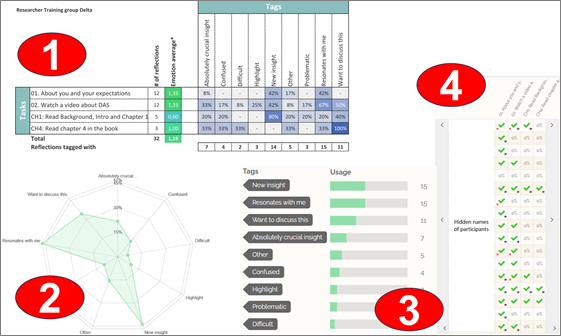
Figure 5.5. Analysis overview with some different views from Loopme to give an early glimpse of the analysis capability of a DAS study.
5.6 Trust, Integrity, Ethics, Anonymity, Risks
An everyday inquiry is built on relational trust. This is perhaps what distinguishes everyday inquiry the most from classic surveys. Even though the conversation takes place in writing and in the digital space, it often resembles more of a confidential verbal conversation. Sometimes even a bit like a deep interview. Participants often share personal thoughts, feelings and experiences in their reflections – things that normally don’t leave the inner conversation. As study leader you therefore manage something very valuable. It’s important to show respect, be clear about purpose and act carefully. Talk openly about how the material will be used, who may read and who may not read, how anonymity is handled and that everything aims at collective learning, not scrutiny. Clear ethics creates trust.
In Loopme there are functions for GDPR compliance that must be used, see figure 5.6 below. The overarching principle behind GDPR legislation is clear – it’s the purpose of storing personal data that is decisive. With a legitimate purpose it’s fine to store personal data for a reasonable time. Therefore be careful to describe the purpose in the group’s field “Why do you need to store the data for this time?”. Also specify a time frame for how long reflections should be stored that is reasonable based on this purpose.
Avoid completely handling particularly sensitive information, defined in GDPR legislation as people’s health, ethnic origin, political opinions, religious or philosophical beliefs, trade union membership or sexual orientation. Inform all participants that such things must not be in their reflections. Remove such things if you see that they come in anyway.
When you share quotes from participants’ reflections with everyone, make sure they cannot be traced to a specific person. Remove names and events that are too specific. Try to preserve the quote’s core, while protecting the person who shared something personal. It can also be good to warn that there is always a small risk that others figure out who wrote something. Best is to never share things that can really cause harm if accidentally spread.

Figure 5.6. Function for specifying data storage time and purpose for a group in Loopme.
5.7 Response Rate, Reflection Depth: What to Expect
In all scientific work and in all data collection there are challenges with response rates. This is also the case with everyday inquiry, and it’s completely normal. Not all participants who are invited will reflect. Not all action tasks will be completed by everyone. Not all reflections will be deep and interesting. It’s common that a mere half of the participants are relatively active. Among the other half, the activity level often gradually drops to zero. If around 20% of participants don’t do a single action task, it is still normal, especially if participation is mandatory. Such is life. It’s also common to see a fatigue effect – for each new action task, the response rate drops somewhat.
There is much that can be done to maintain a high response rate. Above we wrote about how an everyday inquiry should be introduced to create motivation and meaningfulness, but formal leadership also plays a big role. If the top manager at a workplace is present at the start and also often mentions the inquiry work ongoing, the response rate increases. Reminders are important, and can be given in many different forms – manual, relational and automatic. We humans are forgetful when it comes to development, and tend to be consumed by a hectic everyday routine. A well-designed inquiry makes a big difference to response rates – a reasonable number of action tasks that feel meaningful and create value for participants to complete. A relational focus from study leaders also contributes much to response rates.
Writing down one’s personal deep thoughts is an unusual activity in our stressed and heavily streamlined society. Reflection depth therefore often strengthens quite quickly when an everyday inquiry gets going, because participants quickly become better at deep written reflection. They are also often inspired by good examples of others’ reflections, which strengthens reflection depth. A good level of feedback also strengthens reflection depth, because participants then feel that their thoughts are taken seriously and appreciated. It then feels more meaningful to share one’s deep thoughts. Gibbs’ classic reflection cycle shown in figure 5.7 below can be used as support for study leaders in giving structured feedback that triggers deeper reflection. Setting aside time for reflection when everyone meets physically is an effective way to increase both response rate and reflection depth. Giving participants 20 minutes for reflection in silence is often very appreciated. The room fills with delightful keyboard clatter when everyone thinks deeply at the same time.
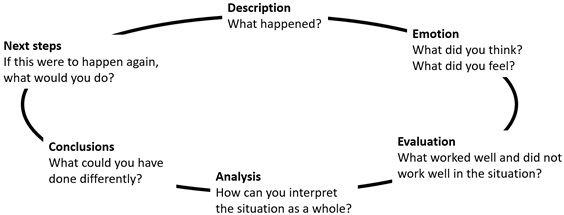
Figure 5.7. Gibbs’ reflection cycle for deepened structured reflection.
Read more:
Gibbs, G. (1988). Learning by doing: A guide to teaching and learning methods.
5.8. End with a Meta-Reflection – Reflect on the Reflecting
A good way to end an everyday inquiry can be to ask participants to look back at all the action tasks they’ve completed, read their earlier reflections, and then try to sum up all the lessons from the whole process. When people read their own reflections in chronological order, learning becomes visible in a way that otherwise easily disappears in everyday noise. They see how their thoughts have deepened, how feelings have varied and how their insights have gradually emerged. It often creates pride, meaning and a sense of coherence. This can also be combined with what is described in the next chapter as a collegial analysis meeting.
It can also be good to give a final action task that is about reflecting on the inquiry process itself. What has it been like to work with everyday DAS inquiry? What has been good and challenging about it? This also provides support for study leaders who may doubt themselves. These meta-reflections can be used to strengthen continued inquiry work.
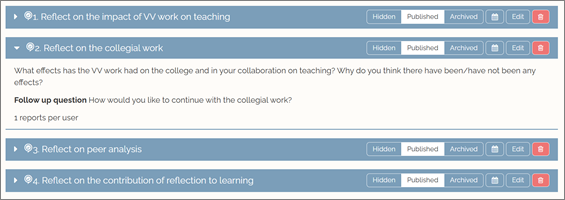
Figure 5.8. An example of four action tasks that strengthen meta-reflection.
5.9 The Reflective Practitioner – Schön’s Ideas into Action with Everyday Inquiry
Already in the 1980s, researcher Donald Schön described a skilled practitioner as a reflective practitioner – a person who not only does, but also thinks and reflects deeply in the doing. She acts in complex situations where manuals are not enough, and learns by pausing in the middle of action (reflection-in-action) and afterwards analysing what happened (reflection-on-action). Schön argued that we need to reflect to understand our own actions in situations where there are no ready-made answers, to be able to think while we do, and thereby constantly refine our professional judgement.
Everyday DAS inquiry helps us with precisely this. When we ask participants to reflect at a certain pace based on short action tasks, we create space for reflection-in-action: the participant acts and thinks simultaneously – writes in direct connection to the event, receives quick response and adjusts the next action. When we show an early analysis overview and let the group interpret patterns, we shift focus to reflection-on-action: participants step out of the situation, see the whole and draw conclusions together.
The choice of hierarchical, flat or hybrid group shapes the social conditions required to become a reflective practitioner – confidentiality when needed, visibility when it benefits collective learning. Principles for integrity and anonymity provide the ethical framework that makes reflection possible without people shutting down out of fear. Measures to increase response rate and reflection depth represent the DAS craft required to keep the rhythm going so that reflection actually happens in a stressful work environment.
Finally, Digital Datadriven Dialogue via the “ball”, the IT tool Loopme, makes Donald Schön’s ideas scalable. The digital tool captures the fleeting moments of thinking-in-doing and stores them as traces that can be revisited later, at analysis meetings and in meta-reflections. This is how a culture of reflection is built step by step, leading to the establishing of a learning organisation where people both act skilfully and learn together as a collective. Being a study leader in an everyday DAS inquiry is thus fundamentally about creating very concrete structures for others’ learning and reflection in their everyday working life. It is all about keeping the process alive, ensuring that action tasks are completed, that reflections are written and that feedback is given in time. This requires that you balance support and demand, are both clear and responsive, and ensure that learning doesn’t get stuck in words and talk but also leads to action and insights in writing. You lead by asking good questions and creating occasions where others get to try out and think for themselves. Leading others’ learning means keeping focus on the purpose, building trust and helping the group see patterns in what happens. When you succeed with this, a learning culture emerges. Reflection becomes a natural part of work, not something extra, but a way to together understand, improve and refine what everyone does. You get the ball rolling, keep the game going, and ensure everyone can participate. But it’s the participants who play.