


Organising for DAS is, at its heart, a leadership task. DAS itself is straightforward, but it requires leadership that holds together structure, priority and psychological safety. Leaders at different levels work together to create an environment where people feel confident enough to experiment, reflect honestly and analyse without preconceptions. Space, conditions and boundaries need to be secured: knowledge of DAS, designated people with responsibility, protected time, a manageable pace, sustained commitment, clear priority over competing demands and well-designed forums for dialogue. DAS also needs to be legitimised—leaders must explain why and how the organisation is now going to work more systematically with action-based learning. When a clear structure is in place, working in everyday inquiry ways becomes natural for everyone.
This chapter begins with the role of formal managers—legitimising the work, giving it direction, and creating a sense of safety. Without a clear “why”, the process loses momentum. We then look at how the work is organised in practice: who does what, when and why. Managers, study leaders, analysts, subject experts and participants all have distinct roles, and everyone needs to know what is expected of them. We also look at what DAS knowledge different roles need, and how time, rhythm and annual planning cycles can give the work a steady pulse. From there, we go deeper into the practical work of study leadership—guiding other people’s learning.
We then explore several leadership philosophies that sit naturally alongside DAS: evidence-based, transformational and trust-based leadership. Evidence-based leadership means that leaders draws on the patterns emerging from DAS analysis and make decisions grounded in real everyday data rather than gut feeling or tradition. Transformational leadership means that leaders use DAS as a tool to inspire, make meaning visible, and draw people into a shared learning journey that helps both individuals and the organisation to grow. Trust-based leadership means that leaders use DAS to build psychological safety and follow staff members’ learning journeys without resorting to control—strengthening trust through attentiveness, transparency and presence.
The chapter closes with some perspectives on community leadership across organisational boundaries—a distinct form of leadership with its own set of possibilities and challenges.
7.1 Legitimising DAS – The Organisation’s Unique Why
Throughout this handbook, I have touched on many different reasons why an organisation might want to work with DAS. There is no need to rehearse them all here. Ultimately, every organisation must carve out its own answers to the question “why DAS?”. Those answers need to be closely connected to the organisation’s own history, current situation, and the direction it wants to move in. Is the goal stronger analytical capacity and wiser decisions? Is it about building a learning organisation? Or is it more about creating a genuine sense of participation among staff? Does an important development initiative need to be followed up? What should now be studied in relation to all the processes already under way?
A strong and lasting answer to “why DAS?” is a prerequisite for leaders and staff to sustain the work over time—long after the initial excitement has faded. Working systematically and in writing with everyone’s learning will always demand more effort than letting it happen spontaneously through gut feeling and corridor conversations. Without a clear “why” anchored among key people in the organisation, DAS will quickly become the latest abandoned fad from enthusiastic champions who ran out of steam.
One way to build a strong “why” is for the leadership team to discuss and write down a long-term vision for what DAS should lead to over three to five years—why that matters, and what steps are needed to get there. Can this vision be illustrated visually? How do we create genuine buy-in among staff? Leadership can also signal the priority of DAS by distributing mandates, spreading knowledge about the method, and protecting time in meetings. DAS can be connected to a leadership philosophy already in place or pointing in the desired direction. Perhaps the leadership team wants to shift the culture away from loose talk and towards action, evidence-based decision-making, and real impact.
Whatever the leadership strategy, there will always be some resistance to DAS from individual staff members and managers who are initially sceptical. This may stem from fear of being scrutinised, anxiety about writing difficulties or other hidden weaknesses being exposed, a culture of control rather than learning, scepticism towards new technology, or simply the stress and unease that comes with any change.
7.2 Organising for DAS – Who Does What, When and Why
In many cases, it is not the most senior manager who leads the everyday inquiry work. That responsibility is often delegated to a person or group close to the manager—someone in a deputy or informal leadership role, ideally someone with a particular interest in development. Guiding colleagues’ learning can certainly be said to fall within the formal manager’s role, but in practice line managers rarely have the time for learning leadership. Alternatively, responsibility for DAS is shared between formal managers and informal study leaders.
DAS involves a number of practical tasks that are best delegated to people who have protected time to work on the details: designing action tasks and tags, preparing and launching digital reflection groups, giving feedback to all participants, and compiling and collectively analysing the data collected. The formal manager, however, is usually deeply involved in deciding what should be studied through DAS—and what is not well suited to DAS. It is also valuable when the formal manager can find time to engage in the practical DAS work itself. We return to the study leader’s role in section 7.5.
Another leadership role that often appears in everyday inquiries is that of subject experts. It is not always possible to bring in an expert, but if it happens, they often take on an advisory role—offering reading suggestions and deeper knowledge within the specific area being studied, so that the organisation has a firmer foundation when formulating inquiry questions, designing action tasks, and analysing data. An expert can bring a research perspective, give concrete meaning to key concepts, and contribute qualified interpretation of the data. Experts sometimes comment directly on participants’ reflections. This tends to be very well received.
IT managers also play an important role in digital support, data protection and privacy. They are often deeply involved at the start-up and implementation stage of IT support for DAS. A common issue they have to handle is login, since many organisations use so-called SSO—Single Sign-On—a technology that simplifies access across different IT systems.
The role and involvement of participants in everyday inquiry work should not be overlooked. They take action, reflect in depth and contribute to the analysis. This is a form of self-leadership that requires courage, initiative and discipline. It often also involves leading others, since participants in their own work frequently guide the people affected by the action tasks they carry out—service users, customers, students and others whose lives are shaped by the value-creating work participants do in practice in a DAS study.
Read more:
Lackéus, M. (2021). Den vetenskapande läraren [The inquiring teacher]. Chapter 10.
7.3 Knowledge of DAS – Who Needs to Know What?
For DAS to work, different roles need different levels of knowledge. The goal is not for everyone to become a methodology expert, but for each person to understand their part in the whole. Managers need enough DAS competence to lead the work, interpret analytical material and make decisions based on data rather than loose opinion. They also need to understand how rhythm, pace and priority affect engagement and data quality.
Study leaders need a deeper understanding of DAS. They must be able to design testable actions, choose tags, conduct formative dialogue in comment threads, and hold the collective analysis together. This means they need to feel confident both in the research logic behind DAS and in the practical steps within the digital tool. That kind of depth only comes through actually running a complete everyday inquiry process with participants—from design all the way through to analysis. Analysis is a specialist skill that not every study leader necessarily needs to master in full. Those who do analyse DAS data in depth need to be able to work with both numbers and text, organise data into thematic summaries, and use AI support in ways that save time and improve the quality of the analysis.
HR professionals and development leads need to understand how DAS connects to professional development, projects, organisational culture and quality improvement work. Project managers need to be able to manage timelines and phases when several DAS cycles are running simultaneously. Subject experts contribute primarily through their knowledge of the specific area being studied, and therefore rarely need deep methodological expertise.
Participants need to understand the purpose of the reflections and how to write in ways that are useful for analysis. New colleagues need a quick introduction, experienced staff need opportunities to go deeper, and the organisation needs a simple method library where the essentials are gathered in one place.
The practitioner training of which this handbook is a part can be used differently depending on role: managers need an overview, study leaders need to work through all the elements in both theory and practice, and other roles can manage with a lighter introduction. Participants need the least DAS knowledge of all—the whole idea of DAS is that anyone can take part without needing to be a methodology expert.
7.4 Time and DAS – Annual Cycles, Rhythm, and Protected Time
Time is often the single most decisive factor in whether DAS works or quietly fades away. The approach itself is simple, but it requires a rhythm and a priority that the organisation holds to even when everyday pressures mount. A clear annual cycle helps create that predictability. It shows when decisions about focus and design should be made, when a new everyday inquiry begins, when action tasks are carried out, when analysis meetings are held, and when decisions are made about possible changes going forward. A well-thought-through annual cycle means DAS does not compete with other processes—it is woven into them. See Figure 7.4 below for an example of a DAS annual cycle.
The rhythm of reflection also needs to be clear. Short reflection immediately after action is the heart of DAS, and leaders need to protect that micro-time. A weekly pulse, reminders and formative comments keep the learning alive. When participants notice that their reflections are being read and responded to promptly, both engagement and data quality increase.
Collective analysis meetings are another important fixed point. They need to be scheduled well in advance, with enough time and frequency to allow the group to work through the material and discuss patterns together. For large groups, a face-to-face meeting may need to be complemented by digital analysis before or after.
Study leaders need particularly well-protected and carefully planned time to design action tasks, comment on reflections, and prepare analysis material. Without this time, quality drops and the pace becomes uneven. The organisation therefore needs to be explicit about which time is set aside, for which key people, and what may need to be removed to create that space.
Ultimately, time leadership in DAS is about defending pace and rhythm when urgent everyday matters compete for attention. It is when the organisation holds on and holds out that the inquiry work becomes sustainable and meaningful.
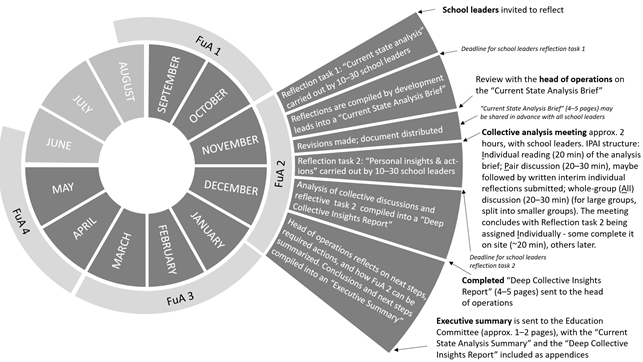
Figur 7.4 An example of an annual cycle for DAS work. Four times a year, all 50 school leaders in a municipality are invited to reflect on a selected Follow-up Area (FuA) (Magnusson et al., 2023).
Read more:
Magnusson, A., Lackéus, M., Ohlsson, K., & Holmén, P.-E. (2023). Praktiknära SKA-arbete: En ny modell för ett mer meningsfullt och mer vetenskapligt systematiskt kvalitetsarbete [Practice-based systematic quality work: A new model for more meaningful and more scientific systematic quality work].
7.5 Study Leadership – A Different Kind of Leadership
The study leader is the hub of everyday inquiry. It is the study leader who brings the DAS method to life—translating the organisation’s most important questions into testable actions, and creating a safe environment where participants feel confident enough to reflect openly. The role is less about knowing everything and more about guiding the process with calm, clarity and curiosity. The study leaders don’t lead people’s day-to-day work, they lead their learning. Trust is built through consistent attentiveness, relational presence and genuine care for participants’ development—while at the same time gently but firmly keeping the group moving forward in a development process that would otherwise easily be crowded out by everyday demands.
The study leader holds the direction throughout the entire cycle, so that the work does not become a series of isolated events but forms part of the organisation’s long-term development logic.
The role is also cultural—keeping collegial curiosity alive and creating a climate where professional practice is shared openly and without prestige. Another central task is setting boundaries around ethics, anonymity and access. Safety is built when everyone knows how their words will be used and by whom. The study leader must be able to represent the group’s learning to managers and others in ways that are both transparent and careful—without exposing individuals or compromising the sense of safety.
Dialogue is the study leader’s primary tool. Short, warm and curious feedback keeps reflections alive. One of the hardest tasks is giving feedback that both affirms and challenges—creating safety while also pushing development forward.
Many study leaders lack formal authority—a kind of middle-leader dilemma—and therefore need clear role boundaries. They are not controllers, experts or managers. They are enablers of learning. In the analysis phase, they lead the process without dominating it, and make sure that many different voices get space. Also sceptical voices are invited in, because these often contribute important nuances to the collective understanding.
Read more:
Lackéus, M. (2021). Den vetenskapande läraren [The inuqiring teacher]. Chapter 10.
7.6 The Manager’s Leadership – Trusting, Learning and Being Emotionally Present
DAS gives managers a new set of leadership tools and methods. With access to a collective “brain” through DAS, leadership can be grounded in the best available knowledge among colleagues to a far greater extent than before. This takes pressure off managers who might otherwise feel they are expected to have all the answers. A climate can more easily be created where staff get to show what they do and know—the insights they hold and generate, the opportunities and challenges they encounter, and how they navigate everyday work through continuous learning. DAS becomes a kind of relational tool that makes it easier for managers to follow staff members’ learning journeys at close range. This resembles the classic idea of “management by walking around”—but in partly digital form. Used well, DAS creates an intimacy in leadership that can otherwise be hard to build in a busy working day.
The manager’s task is to hold the direction without controlling the content too tightly. This means modelling openness by reflecting themselves, normalising uncertainty and showing that feelings are a legitimate part of learning. Emotional leadership becomes central here—when staff share frustration, anxiety or joy in their reflections, managers need to meet those feelings with curiosity rather than judgement. Managers need to demonstrate trust, so that DAS is not perceived as a tool for control but as a tool for learning. Reflections should be used for development rather than performance monitoring. That requires a balance between being present and interested without it becoming surveillance. This often happens in close collaboration with study leaders, who exercise a complementary form of leadership. Quick, warm, brief feedback from the manager can significantly strengthen trust and generate energy in the process.
Managers are also learners in the process. DAS gives them access to rich everyday data that makes it easier to make wiser decisions and understand what is actually happening in the organisation. When managers stand firm in the purpose and hold the rhythm, they create an organisation where deep reflection is normal rather than an exception—where learning becomes a shared concern rather than an individual side project for a few motivated people. The focus should remain on the concrete actions being tried, not on opinions or general reasoning, so that action-based learning stays at the centre. This constitutes a design-based leadership in which the group together designs, tests, adjusts and tests again—where small experiments are seen as a natural way to understand the organisation better.
7.7 Evidence-Based Leadership
Evidence-based management (EBM) is one of the most well-grounded leadership philosophies we have—precisely because it consistently shows that organisations which steer their decisions through data, systematic thinking and reflection perform better than those relying solely on gut feeling, tradition and authority. EBM is about making decisions based on the best available evidence rather than on intuition or organisational myths. It means that leaders systematically collect relevant data, question habitual explanations and let patterns in reality guide what actions to take. EBM also requires formulating clear questions, knowing what data is needed to answer them, and being prepared to revise assumptions when the data points in a different direction. It is a form of leadership that works against cognitive bias, gut-feeling-driven decisions, and the kind of “this is how we’ve always done it” logic that so often slows development. Within EBM, IT support plays a decisive role in leadership, because digital systems make it possible to collect, structure and analyse data in ways that give leaders access to the right evidence at the right time.
In DAS, EBM is translated into a concrete and everyday practice. Managers gain access to real-time data about how the work is actually functioning, and decisions can be made on the basis of concrete actions, feelings and effects—not assumptions. Study leaders drive the process by designing testable actions, analysing patterns and supporting colleagues in seeing what the data actually says. Participants contribute by documenting their actions and reflections, making their knowledge visible in the organisation’s evidence base. In this way, the whole organisation becomes more exploratory, more open to evidence and more willing to change course. IT tools such as Loopme support evidence-based leadership—see Figure 7.7 below.
The deeper meaning of EBM in a DAS context is that leadership becomes a form of intellectual humility: a willingness to ask questions before giving answers, to let reality speak, to acknowledge that no one holds the complete picture. It means a willingness to let go of the control that rests on assumptions, and instead lead through curiosity—designing, testing, listening, analysing and adjusting. It is a leadership style that takes people and data equally seriously, and that sees wisdom as something built collectively, step by step, through the small experiments of everyday work.
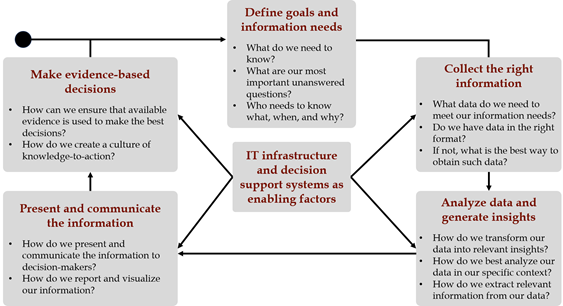
Figure 7.7. A model for EBM illustrating how IT support has a central role in evidence-based leadership (figure revised after Cannon and Doyle, 2020).
Read more:
Cannon, M., & Doyle, C. (2020). Challenges to advancing evidence-based management in organizations: Lessons from Moneyball. Management Teaching Review, 5(4), 363-373.
Pfeffer, J., & Sutton, R. I. (2006). Evidence-based management. Harvard business review, 84(1), 62.
7.8 Transformational and Trust-Based Leadership
Transformational leadership is a philosophy built on awakening people’s intrinsic motivation. Rather than steering primarily through targets, monitoring and rewards—the hallmarks of transactional leadership—transformational leadership directs its attention towards vision, values and meaning. The leader shows where the organisation is heading, why it matters and how each individual can contribute to something larger than their own immediate task. At its core, it means being a role model who stands for clear ideals, articulating an inspiring direction, stimulating critical and creative thinking, and meeting each person with care and support. Figure 7.8 shows how this complements more structure-driven leadership. Stability and follow-up are necessary, but it is vision, intellectual stimulation and relational safety that create genuine capacity for change.
Trust-based leadership is a closely related philosophy, centred on creating a relational safety in which people feel confident enough to be open, try new things, and show uncertainty without fear of being controlled. It rests on confidence in staff members’ competence and willingness to take responsibility, and on the leader strengthening the profession by reducing unnecessary micromanagement and giving genuine room to act. Such leadership is characterised by attentiveness, openness and dialogue—where curiosity comes before suspicion, and where data is used for learning rather than for control. When the profession is trusted, engagement, quality and courage grow organically. In the Swedish context, Bringselius (2017) has developed a framework for trust-based leadership, emphasising autonomy, professional judgement and reduced reliance on control.
In DAS, both transformational and trust-based leadership become concrete and grounded in everyday practice. The vision is expressed through how action tasks are formulated, what inquiry questions are asked, and what patterns are highlighted in the analysis. Action tasks and tags function as markers of what is strategically important—and provide intellectual stimulation by inviting new perspectives and experiments. At the same time, the reflections create a structure in which the leader can invite accountability, offer individualised support, gain sight of the profession’s knowledge, follow people’s development, and see their different needs and strengths. The trust-based perspective becomes central here—staff only share their real actions and thoughts if they feel that the reflections are being used for learning rather than for monitoring performance.
DAS thus becomes a leadership tool in which vision, courage, curiosity and trust are woven together. The leader becomes a catalyst rather than a conductor—someone who helps people find meaning, dare more, draw on their knowledge, and develop together towards a shared vision.
Table 7.8. Transactional and transformational leadership, and their connection to DAS.
| Transactional leadership | Transformational leadership | Connection to DAS |
| Transaction-oriented. Leading through target-setting, conditional rewards and sanctions, based on external motivation. | Charismatic. Leading through clear vision, values and an emotionally engaging overarching purpose that awakens intrinsic motivation. | Vision, ideals, and values can be clarified through the overall set of inquiry questions, action tasks and tags that staff work with through DAS. |
| Deviation-based. Focus on existing ways of working, structures and deviations and problems in the here and now. | Inspiring. Focus on strategic questions, learning and new ways of working that challenge and motivate. | Leaders challenge staff through different action tasks in DAS. Leaders signal in concise terms through DAS what is strategically important, in inquiry questions, tasks and tags. |
| Role-focused. The driving force is individual and plan-driven, centred on the staff member’s own tasks, agenda and goals. | Stimulating. The driving force is collective and vision-driven, centred on intellectual stimulation, critical thinking, creativity and new ideas. | Questions, action tasks and tags in DAS that focus on new ideas and ways of working, stimulating staff intellectually, challenging them, and making them more creative. |
| Hierarchical. Leaders lead by acting on the issues and staff members that are currently demanding attention. | Distributed. Leaders coach each staff member to take initiative and exercise leadership in everyday work. Interaction and honest dialogue with each individual are prioritised. | Reflections on completed actions by each staff member are read by leaders through DAS. Everyone receives individual coaching in a confidential dialogue within DAS. |
Read more:
Anderson, M. (2017). Transformational leadership in education: A review of existing literature. International Social Science Review, 93(1), 1-13.
Bringselius, L. (2017). Tillitsbaserad styrning och ledning: Ett ramverk [Trust-based governance and management: A framework]. (2nd ed.) Tillitsdelegationen.
Westlund, C. (2020). Tillitsbaserat ledarskap i skolan – Från ord till handling [Trust-based leadership in schools – From words to action]. Self-publishing.
7.9 Community Leadership: Leading Learning Across Organisational Boundaries
We have seen many examples of study leaders who grow into the role of leading communities of practice. Leading such a community means creating and holding together a larger group of people who develop their profession collectively. The leader’s primary task is to build a structure that makes it easy to meet, share experiences and explore shared questions. Leaders are responsible for the rhythm—ensuring that meetings recur, that everyday inquiries are followed up, and that learning is kept alive even when everyday pressures push back.
A community becomes particularly powerful when it is led across organisational boundaries. Leaders of such a community bring together strengths and perspectives from different organisations, which leads to richer analysis, greater development capacity and a more varied base of experience. More long-term, community work is also a strategy for more sustainable organisational development. The DAS work becomes more resilient and less dependent on individual people. Community leaders lift local champions, build a culture of development and ensure that the community becomes a self-renewing engine in the long-term learning of several organisations. Figure 7.9 below shows an example vision for such a community.
Leading a community also means cultivating among participants the courage to share personal experiences, the heart to help one another, and the collective analytical capacity—the distributed brain—that DAS gives them. Community leaders make these values visible, strengthen them, and help the group carry the responsibility together.
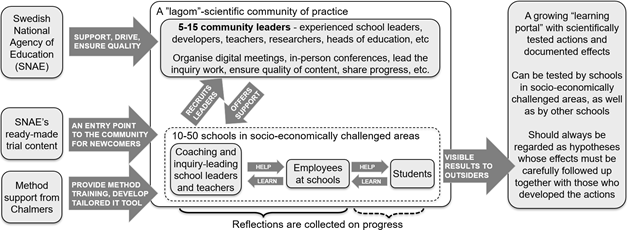
Figure 7.9. A vision for a research-informed “lagom”-scientific community for schools in areas facing socioeconomic challenges (Lackéus, 2024).
Read more:
Lackéus (2024). Hur kan skolledare i utsatta områden få hjälp? Tre etablerade sätt och ett nytt arbetssätt [How can school leaders in disadvantaged areas get support? Three established approaches and one new way of working]. Unpublished essay written for the Swedish National Agency for Education, available on request.
Lackéus, M., & Sävetun, C. (2025). Designed Action Sampling as a new research method to help build active communities in entrepreneurial education. Entrepreneurship Education & Pedagogy, 8(2), 206–239.